Racing history, art deco machines, perfect cocktails & la dolce vita on the Riviera.
8 Articles1929 Grand PrixArt Deco CarsLe TexanMonte Carlo RallyBest Day Ever
SCROLL TO READ
INSIDE THIS ISSUE
8 ARTICLES · MONACO, PRINCIPALITY OF
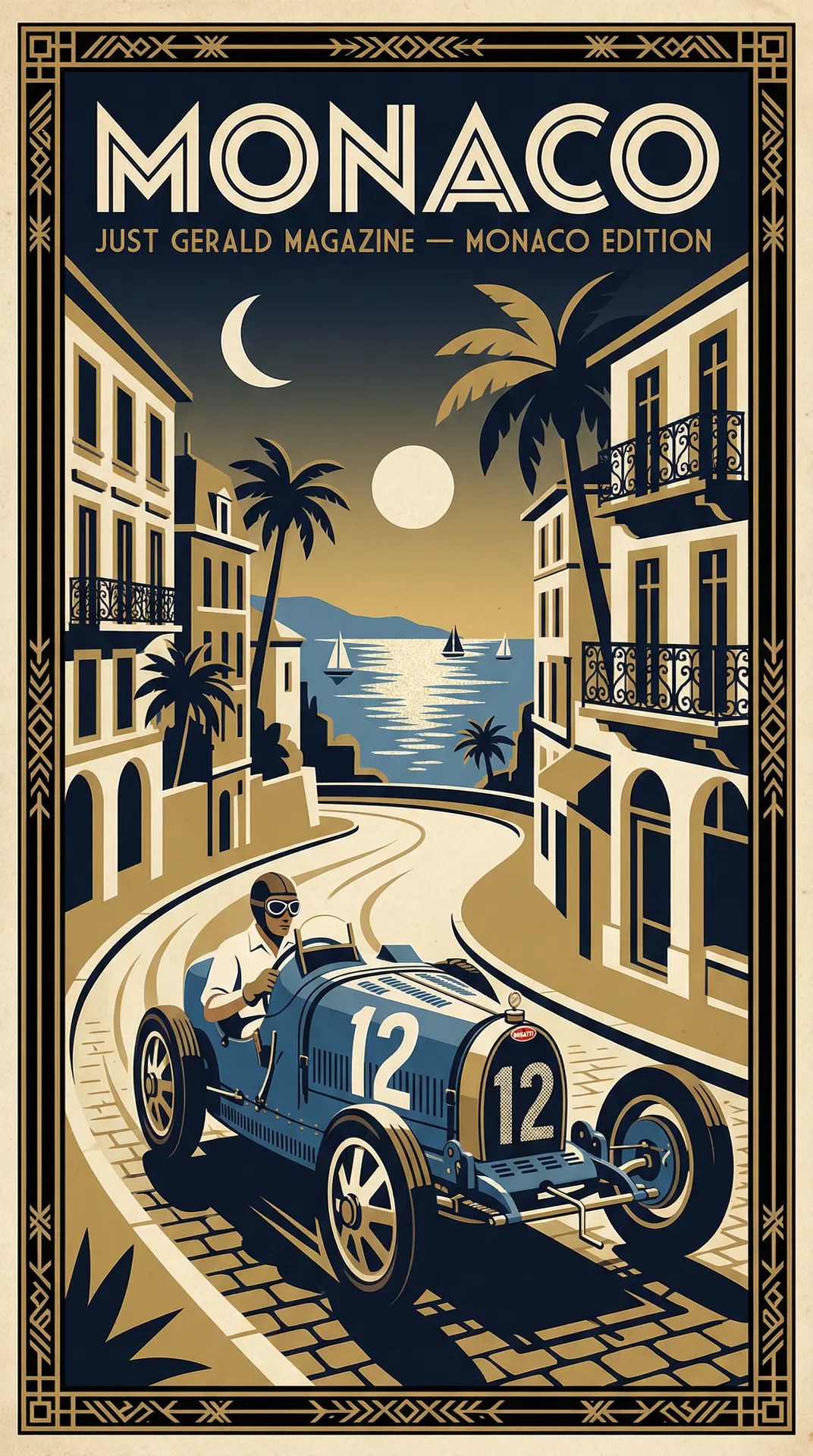
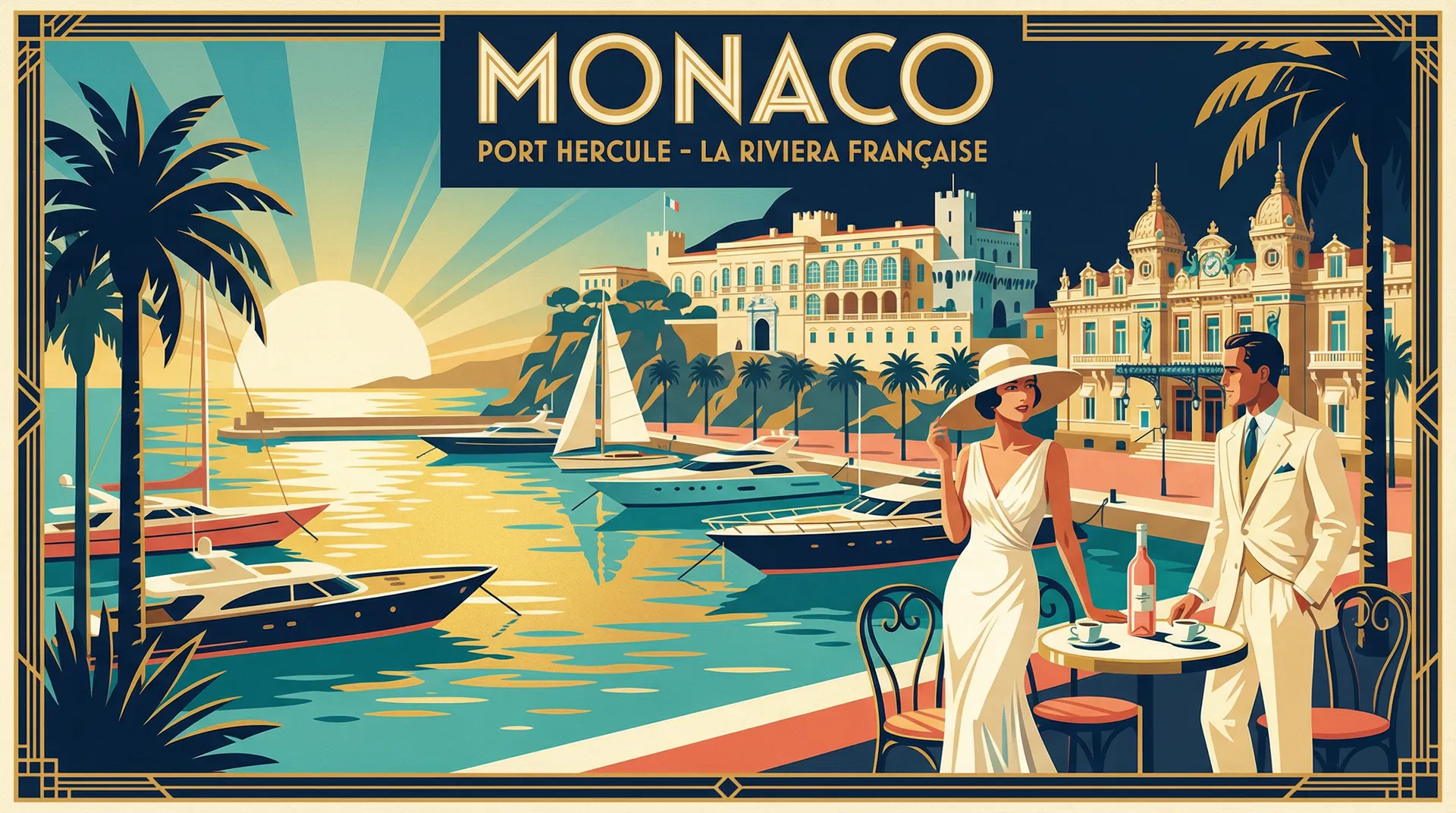
The Monaco Edition -- from the 1929 Grand Prix and the beautiful Bugattis that defined an era, to the bars that have been pouring perfect martinis since before the race existed. This is Monaco: small, glamorous, and absolutely worth the trip.
2
RACING
1
CARS
1
COCKTAILS
1
DINING
1
COFFEE
1
BEST DAY
TABLE OF CONTENTS
Editor's Letter3 min
Editor's Letter: The Smallest Country with the Biggest Story
Welcome to Monaco -- where the hairpins are tighter, the cocktails are colder, and the history is richer than the people.
Monaco DispatchGerald -- Spring 2026
Monaco is 2.02 square kilometres. That's smaller than Central Park. And yet it contains more history per cobblestone than most countries manage in a continent.
01
A Place That Earns Its Reputation
Monaco is 2.02 square kilometres. That's smaller than Central Park. And yet it contains more history per cobblestone than most countries manage in a continent. The Grand Prix circuit alone -- unchanged in its essential geometry since 1929 -- has seen more drama, beauty, and mechanical tragedy than any stretch of road on earth. The Monte Carlo Rally, which predates the Grand Prix by eighteen years, has been sending cars from the far corners of Europe toward this tiny principality since 1911, through snow and fog and mountain passes that would make a sensible person stay home.
We came to Monaco for the obvious reasons -- the race history, the art deco architecture, the bars that have been pouring perfect martinis since before your grandfather was born. We stayed because Monaco rewards the curious. Get past the casino and the superyachts and you find a place with genuine soul: the old town of Monaco-Ville perched on its rock, the Condamine market on a Saturday morning, the Bar Américain at the Hôtel de Paris where the barman has been polishing the same marble counter since 1864.
This issue is about all of it. The Bugatti Type 35B that won the first Grand Prix in 1929. The man who drove it -- William Grover-Williams, who later died a resistance fighter in a Nazi concentration camp, which is a story that deserves to be told more than it is. The Alfa Romeos and Maseratis that followed. The cocktails that were being mixed in the same hotels while the race was happening outside. And the best day you can possibly have in Monaco right now, in 2026, if you know where to go.
You're going to need a good espresso and somewhere to sit. We recommend the terrace at Cova Montenapoleone, with a view of the Casino. Order the cortado. Then read on.
“Monaco rewards the curious. Get past the casino and the superyachts and you find a place with genuine soul.”
THE VERDICT
Monaco rewards the curious. Get past the casino and the superyachts and you find a place with genuine soul.
The Race That Started Everything: Monaco Grand Prix, 1929
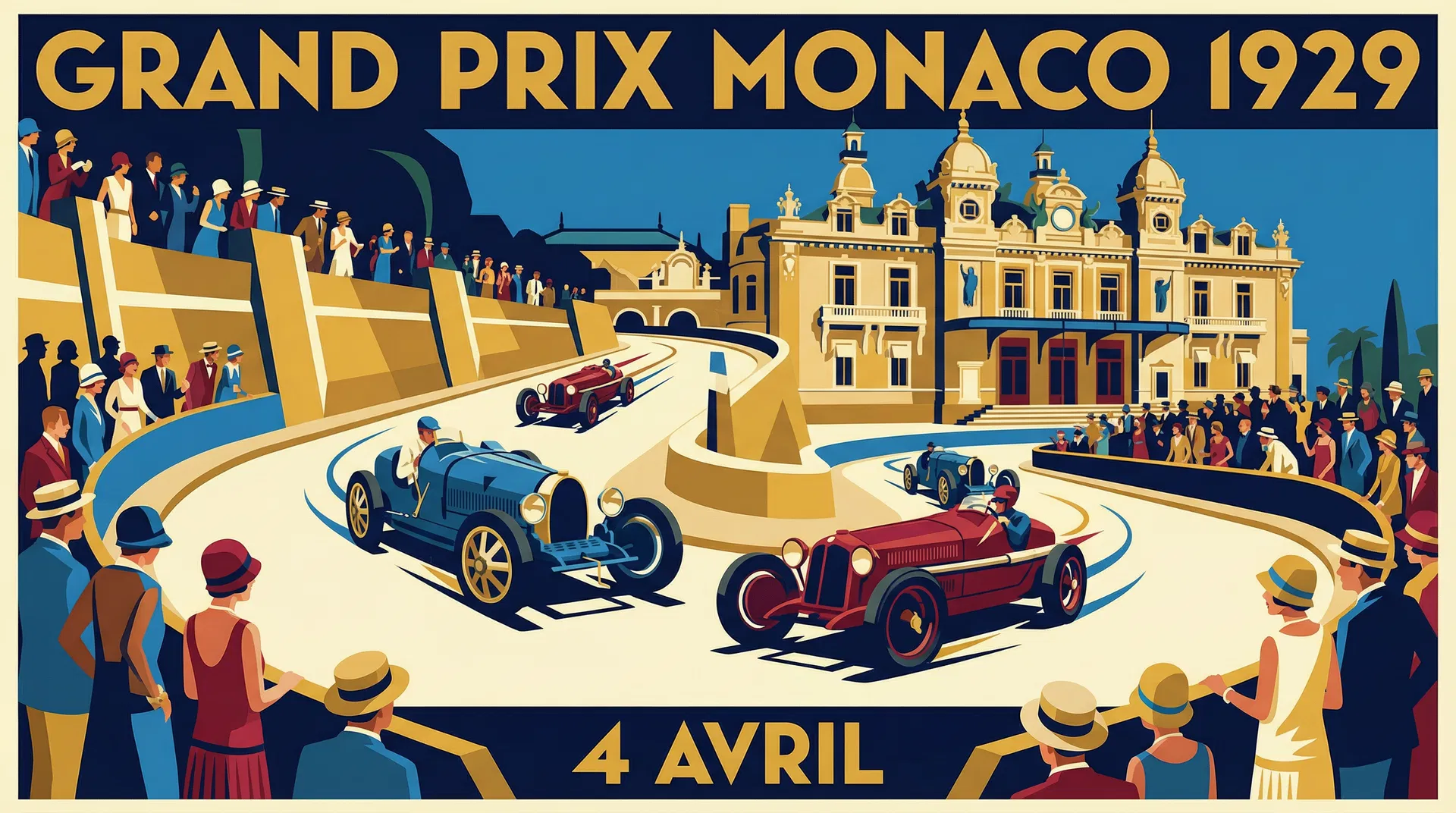
On April 14, 1929, twenty cars lined up on a cobblestone street in Monaco. The world of motorsport was never the same.
Monaco DispatchGerald -- Spring 2026
There was no qualifying. The starting positions were drawn by lot. Twenty drivers -- some of the finest racing talents in the world, and a few who had no business being there -- lined up on a cobblestone street in the middle of Monaco.
01
The Idea That Almost Didn't Happen
The Monaco Grand Prix was the idea of one man: Antony Noghès, the General Commissioner of the Automobile Club de Monaco. He had been watching the Monte Carlo Rally -- which his own father had helped found in 1911 -- bring thousands of spectators to the principality every January, and he thought: what if we ran a proper Grand Prix here? On the streets. Through the city. Around the harbour.
The Automobile Club de Monaco agreed. Prince Louis II gave his blessing. And on April 14, 1929, it happened. The circuit was 3.18 kilometres of public road -- essentially the same layout used today, which is either a tribute to Noghès's genius or evidence that Monaco hasn't changed much in a century, depending on your perspective.
There was no qualifying. The starting positions were drawn by lot. Twenty drivers -- some of the finest racing talents in the world, and a few who had no business being there -- lined up on a cobblestone street in the middle of Monaco. The flag dropped at 1:30pm.
02
The Bugatti and the Man Who Drove It
William Charles Frederick Grover was born in Paris in 1903 to a British father and a French mother, which made him the kind of person who belonged everywhere and nowhere simultaneously. He raced under the pseudonym "W. Williams" -- partly for privacy, partly because it sounded better on a race programme. He had started as a chauffeur to a British painter, who lent him a car to race. He was good enough that Ettore Bugatti himself noticed, and signed him as a works driver.
His car for the 1929 Monaco Grand Prix was a Bugatti Type 35B -- a machine that is, by any measure, one of the most beautiful racing cars ever built. The Type 35 was the product of Ettore Bugatti's obsession with lightness: the engine and gearbox housing were aluminium, the wheels were cast aluminium with integrated brake drums, the body was a narrow, elegant teardrop of French blue. The supercharged 2.3-litre eight-cylinder engine produced 140 horsepower and weighed 750 kilograms. It had won over 2,000 races in the 1920s. It was, in Bugatti's own estimation, not just a racing car but a work of art.
Grover started fifth after the draw. By lap three he was third. By lap twenty he was leading. He pitted on lap 49 -- a mandatory stop that handed the lead briefly to Rudolf Caracciola in a Mercedes SSK -- but came back out with better grip on the hot asphalt and pulled away. After 100 laps and 318 kilometres, he crossed the finish line first. His fastest lap was 2 minutes 15 seconds, an average speed of 84.8 km/h. It was, by the standards of the time, sensational.
“The Bugatti Type 35B was not just a racing car. Ettore Bugatti called it a work of art. He wasn't wrong.”
03
The Field Behind Him
Second place went to Georges Bouriano in another Bugatti Type 35C. Third was Caracciola, who would go on to become one of the greatest drivers of the pre-war era -- three European Championship titles, five German Grand Prix victories, a man who drove in conditions that would have sent modern drivers back to the garage.
The rest of the field was a roll call of the era's finest talent. Philippe Étancelin, who had taken pole position. Louis Chiron, the Monégasque driver who was Grover's business partner in a car dealership and who would win Monaco himself in 1931. Tazio Nuvolari, the Italian who Ferdinand Porsche would later call "the greatest driver of the past, the present, and the future" -- a man so committed to speed that he once raced with a broken leg, and who won the 1932 Monaco Grand Prix in an Alfa Romeo Monza.
The cars themselves were a spectacle. The Bugattis in French blue. The Alfa Romeos in Italian red -- the Scuderia Ferrari cars, run by a young Enzo Ferrari who was still a team manager rather than a manufacturer. The Mercedes in silver. The Maseratis. The Delages. All of them open-cockpit, all of them with drum brakes, all of them driven by men in linen shirts and leather helmets through streets that were not designed for racing at any speed, let alone 140 horsepower.
04
The Man Who Died a Hero
William Grover-Williams won Monaco again in 1930 and 1931. He continued racing until the late 1930s, when the world changed in ways that made Grand Prix racing seem beside the point.
When the Second World War began, Grover moved to Britain and joined the Special Operations Executive -- the SOE, Churchill's "Ministry of Ungentlemanly Warfare." He was parachuted into occupied France near Le Mans, where he helped organise one of the most effective resistance networks in the country. He was arrested by the Gestapo in 1943. He was executed at Sachsenhausen concentration camp in 1945, weeks before the American liberation.
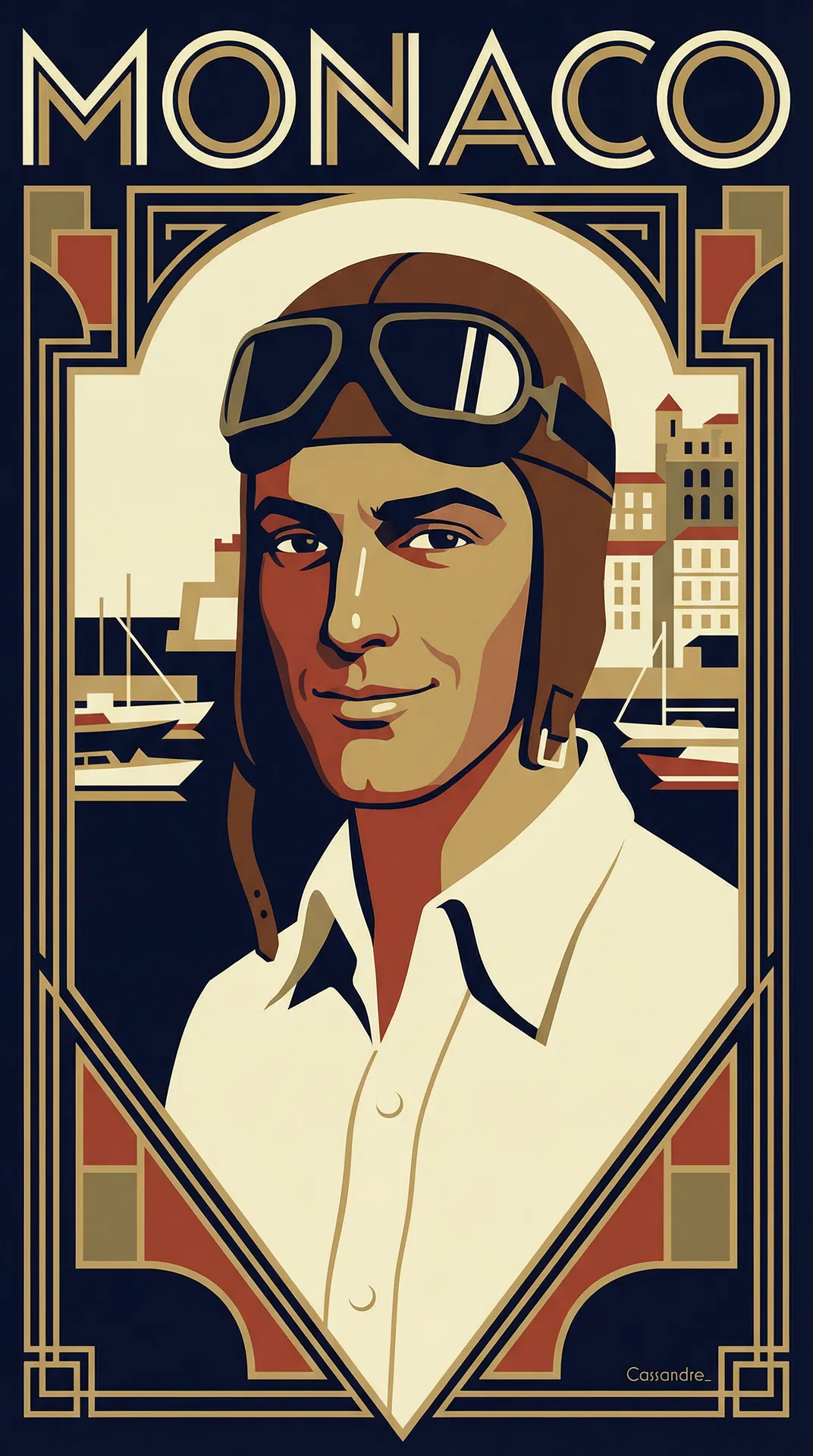
A statue of Grover-Williams now stands at the first corner of the Monaco circuit -- the Sainte-Dévote corner, named for the patron saint of Monaco. He is depicted in his Bugatti, goggles up, looking ahead. It is a good likeness. He deserved better than the end he got.
The 1929 Monaco Grand Prix was the beginning of something that has lasted nearly a century. The circuit is still there. The cobblestones are still there. The hairpin at the Grand Hotel is still the tightest corner in Formula 1. And somewhere in the Automobile Club de Monaco's archives, there is a programme from April 14, 1929, with the name "W. Williams" listed at car number 12.
THE VERDICT
The 1929 Monaco Grand Prix is the founding document of modern motorsport. Walk the circuit. Find the statue. Remember the man.
The Beautiful Machines: Art Deco Racing Cars of the 1930s
Before aerodynamics became a science, racing cars were designed by artists. The results were extraordinary.
Monaco DispatchGerald -- Spring 2026
The 1930s produced the most beautiful racing cars ever built. This is not a matter of opinion -- it is a matter of geometry, proportion, and the fact that nobody had yet invented a wind tunnel.
01
Form Before Function
The 1930s produced the most beautiful racing cars ever built. This is not a matter of opinion -- it is a matter of geometry, proportion, and the fact that nobody had yet invented a wind tunnel. The cars of the art deco era were shaped by intuition, by aesthetics, by the conviction that a beautiful machine would also be a fast one. Sometimes this was wrong. Mostly, it was right.
The art deco movement -- which peaked in the late 1920s and 1930s -- was obsessed with speed, modernity, and the machine age. Its visual language was all geometric precision, streamlined forms, bold contrasts of light and dark, gold and black and cream. The racing cars of the era absorbed this aesthetic completely. They were low and narrow, with long bonnets covering supercharged engines, exposed exhaust pipes running along the flanks, wire-spoke wheels, and cockpits so small that drivers sat with their shoulders above the bodywork. They looked like they were moving even when they were standing still.
“The cars of the art deco era were shaped by intuition, by aesthetics, by the conviction that a beautiful machine would also be a fast one.”
02
The Bugatti Type 35: The Standard of Excellence
Ettore Bugatti was an Italian-born Frenchman who believed that a racing car should be as beautiful as a piece of jewellery. The Type 35, introduced in 1924, was his masterpiece. The aluminium body was hand-formed. The wheels were cast in a single piece, with the brake drums integrated -- a technical innovation that also happened to look extraordinary. The eight-cylinder engine was a work of mechanical sculpture, with a single overhead camshaft and a crankshaft supported by five main bearings.
The Type 35 won over 2,000 races between 1924 and 1931. It came in multiple variants: the Type 35A (for amateurs), the Type 35B (supercharged 2.3-litre, the most powerful), the Type 35C (supercharged 2.0-litre), and the Type 35T (2.3-litre, unsupercharged, for the Targa Florio). All of them were painted in the same French blue -- a colour that became so associated with Bugatti that it is now simply called "Bugatti Blue."
The Type 35B that William Grover-Williams drove to victory in the 1929 Monaco Grand Prix produced 140 horsepower from a 2.3-litre engine with a Roots-type supercharger. It weighed 750 kilograms. It could theoretically reach 215 km/h, though not on the streets of Monaco. It had drum brakes -- four of them, cooled by the famous aluminium wheels. It was, by any measure, the finest racing car of its era.
03
The Alfa Romeo 8C: Italian Red vs. French Blue
If Bugatti represented the French approach to racing -- elegant, precise, jewel-like -- then Alfa Romeo represented the Italian one: passionate, powerful, slightly operatic. The Alfa Romeo 8C 2300 Monza, introduced in 1931, was the car that finally broke Bugatti's dominance at Monaco.
The 8C was designed by Vittorio Jano, an engineer of genius who had previously worked for Fiat. The twin-supercharged 2.3-litre straight-eight engine produced 155 horsepower -- more than the Bugatti -- and the car was lighter and more nimble than its predecessor. It was painted in Italian racing red, which made the battles between the French blue Bugattis and the Italian red Alfas at Monaco in the early 1930s one of the great visual spectacles in motorsport history.
Tazio Nuvolari drove the 8C Monza to victory at Monaco in 1932. Nuvolari was, by any measure, the greatest driver of the pre-war era. He was small -- 5'4" -- and drove in a yellow jersey and blue trousers, which made him easy to spot in the crowd. He was also completely fearless. Ferdinand Porsche called him "the greatest driver of the past, the present, and the future." Enzo Ferrari, who ran the Scuderia Ferrari team that fielded the Alfa Romeos, said simply: "He was the greatest."
The 1933 Monaco Grand Prix was one of the great races of the era -- a battle between Achille Varzi in a Bugatti and Nuvolari in an Alfa Romeo that lasted the entire race. Varzi won by a margin of seconds. Motor Sport magazine described it as "the blue and the red, France and Italy, Varzi and Nuvolari, Bugatti and Alfa Romeo, waging a battle that will be talked about for years." They were right.
04
The Silver Arrows: Germany Arrives
By the mid-1930s, the art deco era of racing was giving way to something more purposeful and, frankly, more sinister. Mercedes-Benz and Auto Union -- both backed by the Nazi government's desire to demonstrate German technological supremacy -- arrived at the circuits with cars of extraordinary power and sophistication. The Mercedes W25 and W125, and the Auto Union Type A through D, were painted silver -- not by choice, but because the German racing authority required cars to be painted in national colours, and the German national colour was white. When the W25 arrived at the 1934 Eifelrennen overweight, the mechanics stripped the white paint to save weight, revealing bare aluminium. The "Silver Arrows" were born.
These cars were faster than anything that had come before -- the W125 produced 592 horsepower in qualifying trim -- but they lacked the visual elegance of the Bugattis and Alfas. They were purpose-built weapons, not works of art. The art deco era of racing was effectively over.
But the cars of 1929 to 1934 -- the Bugatti Type 35B, the Alfa Romeo 8C Monza, the Maserati 8CM -- remain the most beautiful racing machines ever built. They are the cars that define Monaco, that define the era, that define what a racing car can look like when it is designed by someone who cares as much about beauty as about speed.
THE VERDICT
The Bugatti Type 35B, the Alfa Romeo 8C Monza, the Maserati 8CM -- the most beautiful racing machines ever built. Full stop.
The Long Road to Monte Carlo: A History of the Rally
Since 1911, drivers have been setting out from the far corners of Europe -- through snow, fog, and mountain passes -- bound for Monaco.
Monaco DispatchGerald -- Spring 2026
In January 1911, twenty-three cars set out from eleven different cities across Europe. Their destination was Monaco. Their route was whatever they chose.
01
The Original Idea
In January 1911, twenty-three cars set out from eleven different cities across Europe. Their destination was Monaco. Their route was whatever they chose. The event was called the Rallye Monte-Carlo, and it was the invention of Prince Albert I of Monaco, who wanted to demonstrate the reliability of the modern automobile and promote Monaco as a tourist destination in the winter months.
The first winner was Henri Rougier in a Turcat-Méry 25 Hp, who left from Paris and covered 1,020 kilometres to reach Monaco. The judging was partly based on the elegance of the car and the comfort of the passengers -- which caused considerable controversy when the results were announced, and which tells you something about the era. Rougier was declared the winner anyway.
The concept was simple and brilliant: start from anywhere in Europe, converge on Monaco, and the car that arrives in the best condition wins. This meant that the rally was not a race against other competitors -- it was a race against the conditions. Snow in the Alps. Fog in the Massif Central. Ice on the mountain passes. The Monte Carlo Rally was, from the beginning, a test of endurance, navigation, and the ability to keep a car running through a European winter.
02
The Golden Age: 1930s to 1960s
The rally grew rapidly in the 1930s. By 1930 there were 100 entries. By 1953 -- the peak year -- there were 404. Starting points spread across Europe: Paris, Athens, Oslo, Lisbon, Warsaw, Monte Carlo itself. Competitors drove through the night, navigated by map and compass, and arrived in Monaco exhausted, frozen, and triumphant.
The cars of the golden age were extraordinary. Sunbeam-Talbots, Citroën DS, Jaguar Mark VIIs, Ford Zephyrs -- production cars driven by amateurs and professionals alike, often with a co-driver who navigated while the driver focused on keeping the car on the road. The Monte Carlo Rally was, uniquely, a competition that anyone could enter. You did not need a factory team or a racing licence. You needed a reliable car, a good co-driver, and the willingness to drive through a European winter.
The 1966 rally was the most controversial in the event's history. The first four finishers -- three Mini-Coopers driven by Timo Mäkinen, Rauno Aaltonen, Paddy Hopkirk, and Roger Clark's Ford Cortina -- were all disqualified on a technicality involving headlight bulbs. The winner by default was Pauli Toivonen in a Citroën ID, who found the situation so embarrassing that he refused to accept his award. The headline in Motor Sport read: "The Monte Carlo Fiasco." Teams threatened to boycott. The event survived, but its reputation was damaged.
“The Monte Carlo Rally was, from the beginning, a test of endurance, navigation, and the ability to keep a car running through a European winter.”
03
The Col de Turini: The Night of the Long Knives
The most famous stage in the Monte Carlo Rally is the Col de Turini -- a 31-kilometre mountain road that runs from La Bollène-Vésubie to Sospel, over a pass at 1,607 metres that is almost always covered in ice and snow in January. The stage is run at night. Thousands of spectators line the road, many of them throwing snow onto the tarmac to make it more difficult. The headlights of the cars cut through the darkness like knives -- which is why the stage is known as the "Night of the Long Knives."
The Turini is everything that makes the Monte Carlo Rally unique: the combination of technical difficulty, extreme conditions, and spectacular scenery that no other rally stage can match. Sébastien Loeb set one of the fastest times in the modern era there in 2005 -- 21 minutes 40 seconds for 31 kilometres of mountain road, at night, in January. It is, by any measure, one of the great tests in motorsport.
The rally is still running. It is now part of the FIA World Rally Championship, and the cars are 300-horsepower all-wheel-drive machines that bear no resemblance to the Turcat-Méry that Henri Rougier drove in 1911. But the route is essentially the same. The Col de Turini is still there. The snow is still there. And every January, drivers still set out from the far corners of Europe, bound for Monaco.
THE VERDICT
The Monte Carlo Rally has been running for 115 years. It will be running for another 115. Some things are simply too good to stop.
Monaco has been making excellent cocktails since before most of us were born. Here is where to find the best of them.
Monaco DispatchGerald -- Spring 2026
Monaco has a bar problem. Not a shortage -- quite the opposite. The problem is that there are too many places serving cocktails in extraordinary rooms with extraordinary views, and not enough evenings to drink in all of them.
01
Bar Américain -- Hôtel de Paris Monte-Carlo
5/5
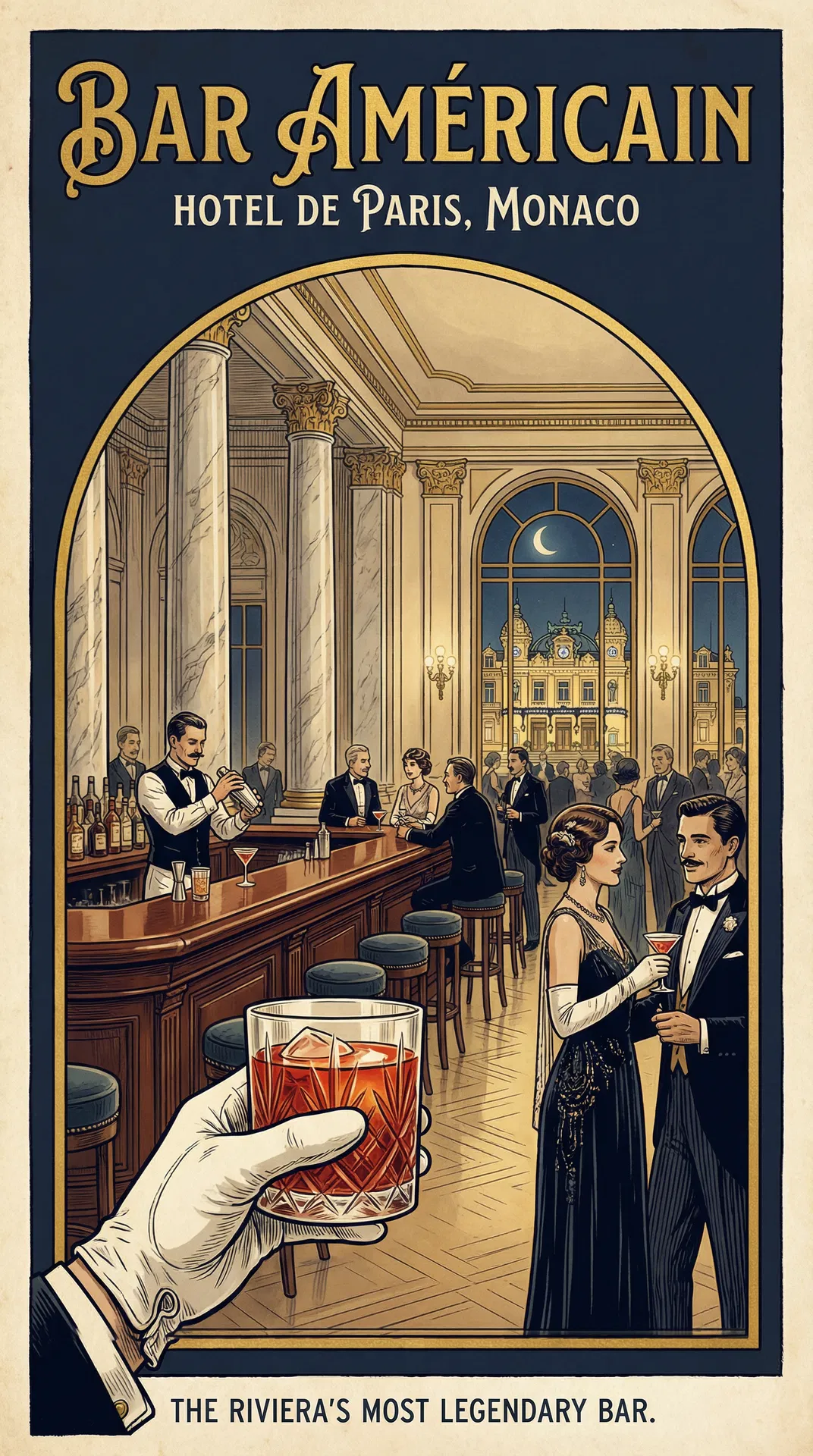
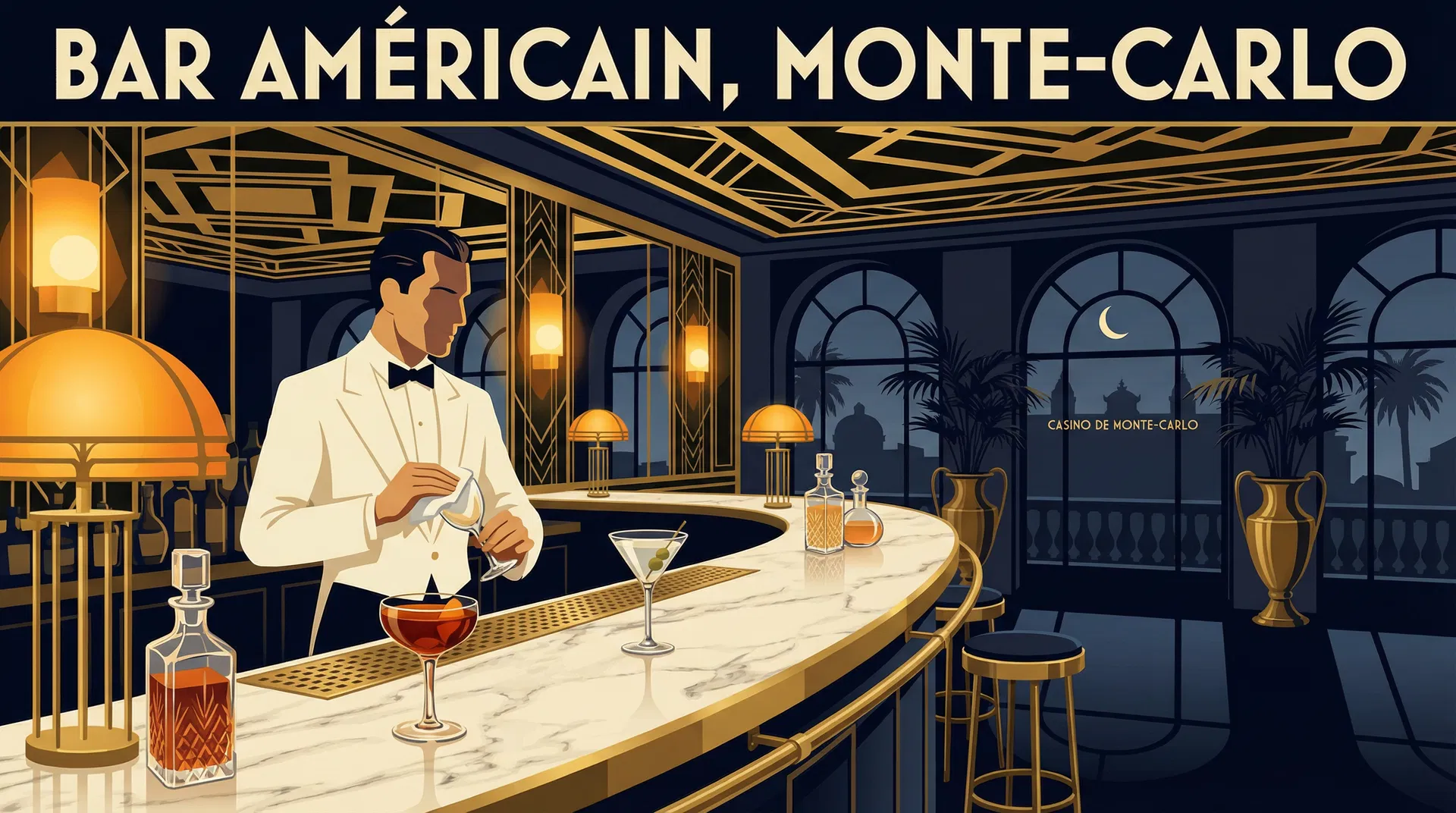
The Hôtel de Paris has been standing on Casino Square since 1864. The Bar Américain has been serving cocktails inside it for almost as long. It is, by any measure, one of the great hotel bars in the world -- not because of the view (though the view of the Casino is excellent), not because of the prices (which are what you would expect), but because of the atmosphere. This is a bar that has been doing the same thing, in the same room, for over a century. The marble counter is original. The brass fittings are original. The barmen know what they are doing.
The house martini is made with Noilly Prat vermouth and a gin of your choosing, stirred to the correct temperature, served in a coupe glass with a single olive. It is not the most innovative cocktail you will ever drink. It is, however, the most correct. The Negroni is similarly impeccable -- Campari, sweet vermouth, gin, stirred, orange peel expressed over the glass. Nothing more. Nothing less.
The Bar Américain is the kind of place where you dress for dinner and mean it. It is also the kind of place where, if you arrive at 6pm and order a martini, you will still be there at 9pm, and you will not have noticed the time passing.
JUST GERALD SAYS
Location
Place du Casino, Monte-Carlo
Hours
Daily from 11am
Must Order
The house martini
Dress Code
Smart -- and mean it
02
Blue Gin -- Monte-Carlo Bay Hotel
4/5
The Blue Gin is Monaco's answer to the question: what if a cocktail bar had a terrace overlooking the Mediterranean? The answer is: it would be very good, and you would spend more time there than you planned.
The bar is part of the Monte-Carlo Bay Hotel & Resort, and its terrace extends over the water -- literally over the water, with the Mediterranean below and the Riviera coastline stretching in both directions. In summer, this is one of the finest places to drink in Europe. In winter, the enclosed bar is warm and intimate, with a cocktail list that leans heavily on gin (as the name suggests) and Mediterranean botanicals.
The signature cocktail is the Blue Gin Spritz -- house-infused gin with Mediterranean herbs, prosecco, and a sprig of rosemary. It is better than it sounds. The gin selection is extensive -- over 80 varieties -- and the barmen are knowledgeable enough to recommend something specific rather than just pointing at the shelf.
JUST GERALD SAYS
Location
40 Avenue Princesse Grace
Hours
Daily from 6:30pm
Must Order
Blue Gin Spritz at sunset
Best For
Sunset aperitivo, Mediterranean views
03
COYA Monte-Carlo
4/5
COYA is a Peruvian restaurant and bar that has no business being this good in Monaco, and yet here we are. The cocktail programme is built around pisco -- the Peruvian grape brandy that is the basis for the Pisco Sour, one of the great cocktails of the world -- and the results are consistently excellent.
The Pisco Sour at COYA is made correctly: pisco, lime juice, simple syrup, egg white, Angostura bitters. It is shaken hard, served cold, and arrives with a foam cap that holds the bitters pattern for long enough to admire before drinking. The Chilcano -- pisco, ginger beer, lime, Angostura -- is equally good, and more appropriate for a warm evening on the terrace.
The food is also worth noting. The ceviche is excellent. The tiradito is better. But you are here for the cocktails, and the cocktails are the reason to come.
JUST GERALD SAYS
Location
10 Avenue Princesse Grace
Must Order
Pisco Sour, then the Chilcano
Best For
Cocktails and ceviche
04
Café de Paris -- Casino Square
3/5
The Café de Paris is not a cocktail bar. It is a brasserie -- a large, loud, tourist-heavy brasserie on Casino Square that has been there since 1882. It is also, despite all of this, worth visiting.
The reason is simple: the location. Sitting on the terrace of the Café de Paris, with a glass of rosé and a croque monsieur, watching the Ferraris and Lamborghinis circle Casino Square, is one of the essential Monaco experiences. It is not subtle. It is not cheap. It is, however, exactly what Monaco looks like, and you should see it at least once.
The coffee is good -- a proper Italian-style espresso, served in a small cup with a piece of dark chocolate. The rosé is cold. The people-watching is world-class.
JUST GERALD SAYS
Location
Place du Casino
Must Order
Espresso and a glass of rosé
Best For
People-watching, the terrace experience
THE VERDICT
The Bar Américain is the reason to come. The Blue Gin terrace is the reason to stay. The Café de Paris terrace is the reason to understand Monaco.
One perfect day in the world's most glamorous principality -- from espresso at sunrise to a martini at midnight.
Monaco DispatchGerald -- Spring 2026
Monaco is 2.02 square kilometres. You can walk across it in twenty minutes. This is not a problem -- it means you can do everything in a single day, if you plan it right.
01
7:30am -- Espresso at Cova Montenapoleone
Start at Cova Montenapoleone, the Milanese café on the Avenue des Beaux-Arts, a short walk from the Casino. It opens early enough to catch the morning light on Casino Square before the crowds arrive.
Order the cortado -- a double espresso cut with a small amount of warm milk, served in a glass. It is the correct morning coffee for Monaco: strong enough to wake you up, small enough to drink quickly. Sit at a window table if you can. The pastries are excellent -- the cornetto is made fresh every morning, and the almond croissant is worth the calories.
The room is all dark wood and marble and brass, which is exactly right for Monaco at 7:30am.
02
9:00am -- Monaco-Ville: The Old Town
Take the lift from the port up to Monaco-Ville -- the old town on the rock, which is the original Monaco. It is a medieval village perched on a cliff above the Mediterranean, and it is genuinely beautiful.
Walk to the Prince's Palace, which has been the residence of the Grimaldi family since 1297. The changing of the guard happens at 11:55am every day -- it is brief and worth watching. Walk to the Cathédrale Notre-Dame-Immaculée, where Grace Kelly is buried. The tomb is simple -- a flat marble slab with her name and dates. It is, for reasons that are hard to articulate, genuinely moving.
Walk to the edge of the rock and look out over the Mediterranean. On a clear day you can see the Italian coast. On any day, the view is extraordinary.
03
12:30pm -- Lunch at La Marée
Come down from the rock and walk to La Marée, on the Quai des Sanbarbani in the Condamine district. It is a seafood restaurant on the port, with a terrace that looks directly at the yachts moored in Port Hercule.
Order the bouillabaisse if it is on the menu. If not, the grilled sea bass with fennel and olive oil is excellent. The wine list is heavy on Provençal rosé, which is correct. Order a half-bottle of Domaines Ott Clos Mireille and drink it slowly.
After lunch, walk along the port. The yachts are extraordinary -- some of them are the size of small apartment buildings, and all of them are immaculately maintained.
04
3:00pm -- Walk the Circuit de Monaco
Walk the circuit. Not all of it -- it is 3.337 kilometres -- but the important parts. Start at Sainte-Dévote, the first corner, where the statue of William Grover-Williams stands in his Bugatti. Walk up the hill to Casino Square, where the cars go airborne on the approach to the corner. Walk down to the Mirabeau hairpin, the tightest corner on the circuit. Walk through the tunnel.
Stand at the Nouvelle Chicane and look at the harbour. This is the view that appears in every Monaco Grand Prix broadcast -- the yachts, the rock, the Casino in the background. It is, in person, even more beautiful than it looks on television.
The circuit is a public road for 51 weeks of the year. The barriers come down after the Grand Prix and the streets return to normal. But the geometry is still there -- the camber, the walls, the barriers. You can feel it when you walk it.
“Stand at the Nouvelle Chicane and look at the harbour. It is, in person, even more beautiful than it looks on television.”
05
6:30pm -- Aperitivo at Blue Gin
Take a taxi to the Monte-Carlo Bay Hotel and sit on the terrace at Blue Gin. Order the Blue Gin Spritz and watch the sun go down over the Mediterranean. This is the best hour of the day in Monaco -- the light is golden, the temperature drops to something comfortable, and the Riviera stretches away in both directions.
If you are hungry, the bar serves small plates -- charcuterie, cheese, olives, bread. They are good enough to tide you over until dinner. If you are not hungry, order a second spritz and stay until the sky turns dark.
06
9:00pm -- Dinner, Then a Martini
Dinner at Elsa, the Michelin-starred restaurant at the Monte-Carlo Beach Hotel. It is the first fully organic Michelin-starred restaurant in the world. The menu changes with the seasons and the market; the tasting menu is seven courses and takes about two hours. The wine list is excellent, with a strong selection of Provençal and Italian wines.
After dinner, walk to the Hôtel de Paris and sit at the Bar Américain. Order a martini. Dress appropriately. Do not take photographs of other guests.
The martini will arrive cold, correct, and in a coupe glass. The room will be warm and quiet and exactly right. Outside, Casino Square will be lit up, and the Ferraris will still be circling. Monaco will be doing what Monaco does -- being Monaco, at midnight, in the way that only Monaco can.
This is the best day ever. You are welcome.
THE VERDICT
Monaco in a day: espresso at sunrise, the old town on the rock, the circuit on foot, sunset at Blue Gin, martini at midnight. Do it properly.
Espresso on the Riviera: Where to Find a Proper Coffee in Monaco
Monaco is surrounded by Italy. The coffee should be excellent. Mostly, it is.
Monaco DispatchGerald -- Spring 2026
Monaco is two kilometres from the Italian border. The coffee culture reflects this -- espresso is taken seriously, served small, and drunk standing at the bar if you are local and sitting at a table if you are not.
01
The Monaco Coffee Landscape
Monaco is two kilometres from the Italian border. The coffee culture reflects this -- espresso is taken seriously, served small, and drunk standing at the bar if you are local and sitting at a table if you are not. The Italian influence means that the standard of espresso is generally high, and that ordering a "large coffee" will get you a look of mild contempt from the barman.
The best coffee in Monaco is not at the most famous establishments. The Café de Paris on Casino Square serves a perfectly acceptable espresso, but you are paying for the location, not the coffee. The Hotel de Paris serves coffee in the lobby that is excellent, but again: you are paying for the room.
The best coffee is at the smaller places -- the neighbourhood cafés in the Condamine district, the pastry shops in Monaco-Ville, the places that locals actually use.
“The best coffee in Monaco is not at the most famous establishments. The best coffee is at the smaller places -- the neighbourhood cafés that locals actually use.”
02
Where to Go
**Cova Montenapoleone** (Avenue des Beaux-Arts) is the best coffee in Monaco for the combination of quality and atmosphere. The cortado is excellent. The almond croissant is worth the detour. The room is beautiful. It is also the most expensive coffee in Monaco, which is saying something.
**Le Petit Café Robuchon** (Place du Casino) is the café arm of Joël Robuchon's Monaco empire, and the coffee is exactly what you would expect from a Robuchon establishment: precise, consistent, and served with a small piece of chocolate. The espresso is a single-origin blend that changes seasonally. The pastries are extraordinary.
**Amù Monte Carlo** (Avenue des Spélugues) is the local favourite -- a neighbourhood café that serves excellent espresso at prices that are merely expensive rather than extraordinary. The terrace is small but pleasant. The barista knows what he is doing. The clientele is a mixture of locals and hotel guests who have found their way off the main tourist circuit.
**Just Gerald Says:** Stand at the bar at Amù. Order a doppio. Drink it in two minutes. This is how Monaco drinks coffee.
JUST GERALD SAYS
Best Overall
Cova Montenapoleone -- Avenue des Beaux-Arts
Best Value
Amù Monte Carlo -- Avenue des Spélugues
Most Precise
Le Petit Café Robuchon -- Place du Casino
Best View
Café de Paris terrace -- Casino Square
THE VERDICT
Stand at the bar at Amù. Order a doppio. Drink it in two minutes. This is how Monaco drinks coffee.
Le Texan: The Most Incongruous Restaurant in the World's Most Glamorous Principality
Princess Grace wanted Tex-Mex. Monaco obliged. Sixty years later, the margaritas are still the best on the Cote d'Azur.
Monaco DispatchGerald -- Spring 2026
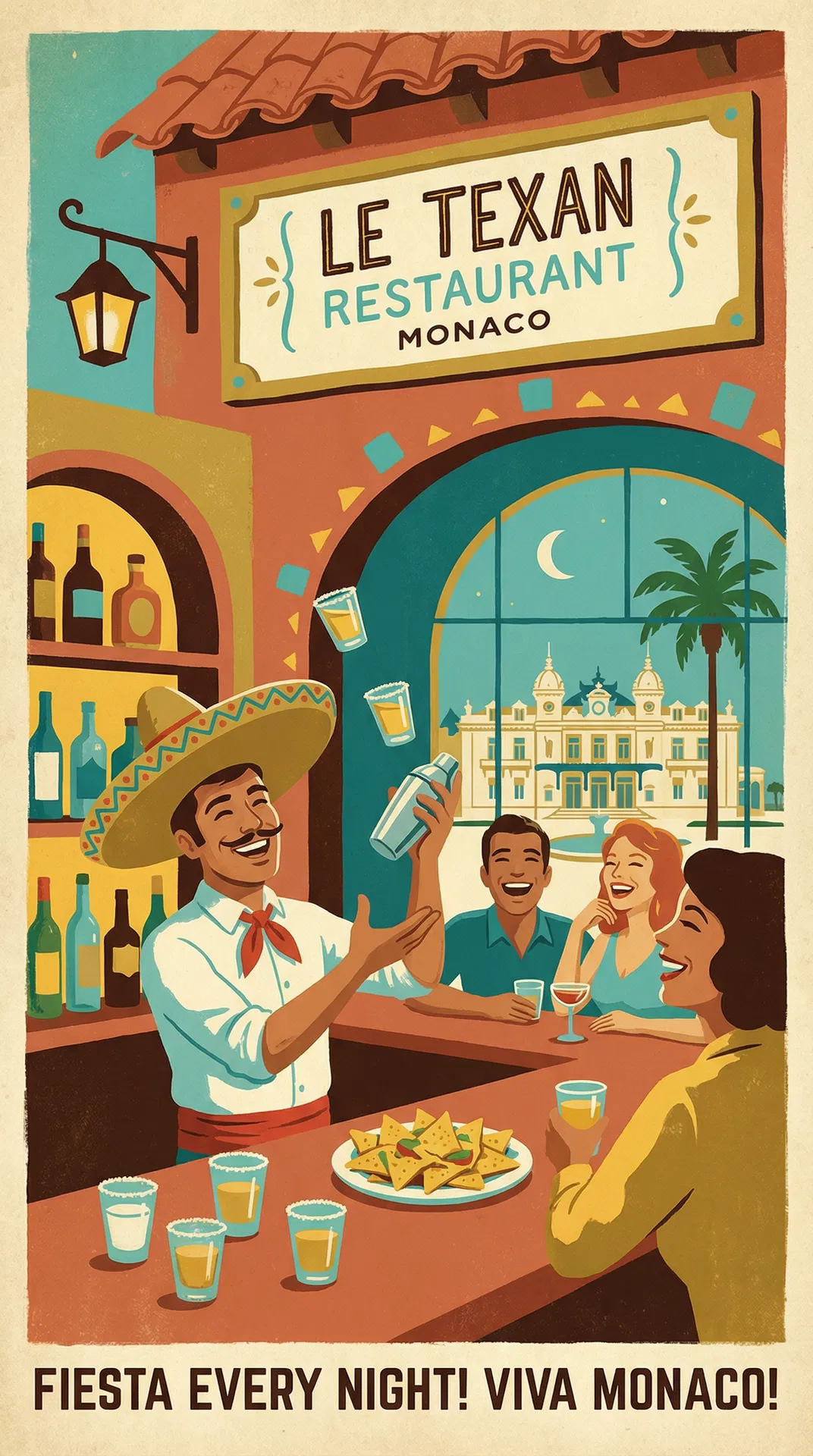
There is a Tex-Mex restaurant in Monaco. It has been there since the 1950s. It was opened at the suggestion of Princess Grace. Michael Douglas eats there. Boris Becker eats there. Members of the Prince's family eat there without reservations, and the staff joke about it. The margaritas are, by general consensus, the best on the Cote d'Azur. None of this makes any sense, and all of it is true.
01
The Origin Story
The story of Le Texan begins, as so many good Monaco stories do, with Princess Grace. Grace Kelly -- Philadelphia-born, Hollywood-trained, married into one of Europe's oldest royal families -- found herself in the 1950s living in a two-square-kilometre principality on the French Riviera, surrounded by the finest French cuisine on earth, and missing Tex-Mex food. This is, if you think about it, a very human thing. You can have access to everything, and still want the thing you grew up with.
She mentioned this to Kate Powers, an American expat who had moved to Monaco from the United States and who understood, instinctively, what the Princess was describing. Powers, along with her brother Mike, opened Le Texan in La Condamine -- the working-class harbour district, not Casino Square, which tells you everything about the restaurant's attitude. It was not trying to be Monaco. It was trying to be Texas. In Monaco. Which, it turned out, was exactly what Monaco needed.
“Princess Grace missed Tex-Mex. Monaco obliged. The margaritas have been the best on the Cote d'Azur ever since.”
02
The Atmosphere
Peter Kurth, writing in 2025, called Le Texan "the Riviera's answer to Cheers." This is accurate. The place has the specific warmth of a restaurant that knows it doesn't need to impress anyone -- it has already impressed everyone who matters. Every table is full. The noise level is cheerful rather than deafening. The staff greet strangers with the friendliness of people who have been doing this for decades and have decided, collectively, that they enjoy it.
The clientele is the most democratic in Monaco. Michael Douglas has eaten here. Boris Becker has eaten here. Members of the Grimaldi family -- the Prince's family, "Up There" in Monaco's social geography -- eat here without reservations, and the staff will joke about it: "What was the name again?" This is the blue-jeans version of Monaco, the casual extension of the larger experience. Fashionable, predictable, dependable, and -- because it is, at its heart, a Tex-Mex joint -- gloriously incongruous.
03
The Margaritas
The margaritas are the reason you come. They are described, consistently and across multiple decades of reviews, as the best on the Cote d'Azur. This is a significant claim on a coastline that takes its cocktails seriously, but nobody has successfully disputed it. They are made properly -- tequila, triple sec, fresh lime, salt rim -- without the shortcuts that lesser establishments take when they think nobody is paying attention. In Monaco, somebody is always paying attention.
Order a pitcher. You will not regret this. The third one is inadvisable but inevitable, which is, as it happens, the Just Gerald standard for any cocktail worth recommending.
“The third margarita is inadvisable but inevitable. This is the Just Gerald standard for any cocktail worth recommending.”
04
The Food
The menu is Tex-Mex, executed with the confidence of a kitchen that has been doing this for sixty years and has no intention of changing. Nachos, enchiladas, fajitas, chilli. The kind of food that is not trying to be anything other than what it is, which in Monaco -- where everything is trying to be something -- is a radical act.
The portions are generous by Riviera standards, which is to say they are normal by any other standard. The prices are reasonable by Monaco standards, which is to say they are still Monaco prices, but you will not leave feeling robbed. Kate Powers, who ran the restaurant until her death in August 2023 at the age of -- well, she was Monaco, so we won't say -- understood that the point of Le Texan was never the food. The food was the excuse. The point was the room, the noise, the margaritas, and the feeling that you were somewhere that had earned its reputation the old-fashioned way: by being genuinely good, for a very long time.
05
A Note on Kate Powers
Kate Powers died in August 2023 after a short illness. She had lived in Monaco since the 1950s, had founded Le Texan and later Stars'N'Bars, had become a Monegasque citizen in 2009, and had been awarded the Order of Saint Charles -- Monaco's highest honour, given to outstanding citizens. Stars'N'Bars, the family-friendly sports bar she founded with her partner Didier Rubiolo, had already closed in January 2023, after nearly thirty years.
Le Texan continues. It is, at this point, one of the oldest continuously operating restaurants in Monaco, and certainly the only one that was founded on the recommendation of a Hollywood princess who missed burritos. This seems like exactly the right legacy.
Go. Order the margaritas. Raise a glass to Kate Powers, who understood that the best restaurants are never really about the food.
THE VERDICT
The best margaritas on the Cote d'Azur, in the most incongruous setting imaginable. Le Texan is proof that the best restaurants earn their reputation by being genuinely good, for a very long time. Go.
Two paths through Best Days Ever: Monaco Grand Prix. Every decision already made. Choose your day.
Solo / Couple
8:00am
Wake Up Right
Hôtel de Paris Monte-Carlo — Place du Casino, Monaco
The grande dame of Monaco hotels, directly on Casino Square. Breakfast in the Le Louis XV dining room — Alain Ducasse's three-Michelin-star restaurant serving the most theatrical morning meal on the Riviera. Order the viennoiseries and a café crème. Take your time.
Gerald says: Request a room facing the Casino. The view of the square at dawn, before the crowds arrive, is the whole point.
9:30am
First Coffee
Café de Paris — Place du Casino, Monaco
The legendary brasserie on Casino Square. Order a double espresso and sit outside. Watch the Ferraris park. This is Monaco — the theatre starts early.
Gerald says: The terrace is the only place to sit. Inside is for tourists who don't know better.
10:30am
The Circuit
Circuit de Monaco — Harbour Chicane — Quai Albert 1er, Monaco
Walk the circuit. Start at the harbour chicane, walk up to Casino Square, down through Mirabeau, through the tunnel, and back along the harbour. The whole circuit is 3.337km. Walking it takes 45 minutes. Understanding it takes a lifetime.
Gerald says: Stand at the Loews Hairpin. It's the slowest corner on the calendar — and the most dramatic. The barriers are inches from the cars.
12:30pm
Lunch
Le Texan — 4 Rue Suffren Reymond, Monaco
Monaco's beloved Tex-Mex institution, open since 1979. The fajitas are the correct order. Cold Coronas. The walls are covered in racing memorabilia. This is where the mechanics eat.
Gerald says: Book ahead. It fills up fast and the locals know it.
2:30pm
The Collection
Collection de Voitures Anciennes — 98 Boulevard du Jardin Exotique, Monaco
Prince Rainier III's personal collection of over 100 historic vehicles. The 1929 Bugatti Type 35 that won the first Monaco Grand Prix is here. So is a 1952 Lancia Aurelia Spider and a 1963 Ferrari 250 GT. This is not a museum. It's a private obsession made public.
Gerald says: Allow two hours minimum. The basement level has the racing cars. Don't rush past them.
5:00pm
Sundowners
Bar Américain — Hôtel de Paris — Place du Casino, Monaco
The most elegant bar on the Riviera. Order a Negroni. The bar has been serving Monaco's finest since 1864. The leather banquettes, the Belle Époque ceiling, the light at 5pm through the tall windows — this is what Monaco is actually for.
Gerald says: Dress appropriately. The Bar Américain has a dress code and enforces it.
8:00pm
Dinner
Le Louis XV — Alain Ducasse — Hôtel de Paris, Place du Casino, Monaco
Three Michelin stars. The most celebrated restaurant in Monaco. The tasting menu is a commitment — four hours, ten courses, a wine list that runs to 400,000 bottles. Book months in advance. Dress for it. This is the best meal you will eat this year.
Gerald says: The sommelier's wine pairings are exceptional. Trust them completely.