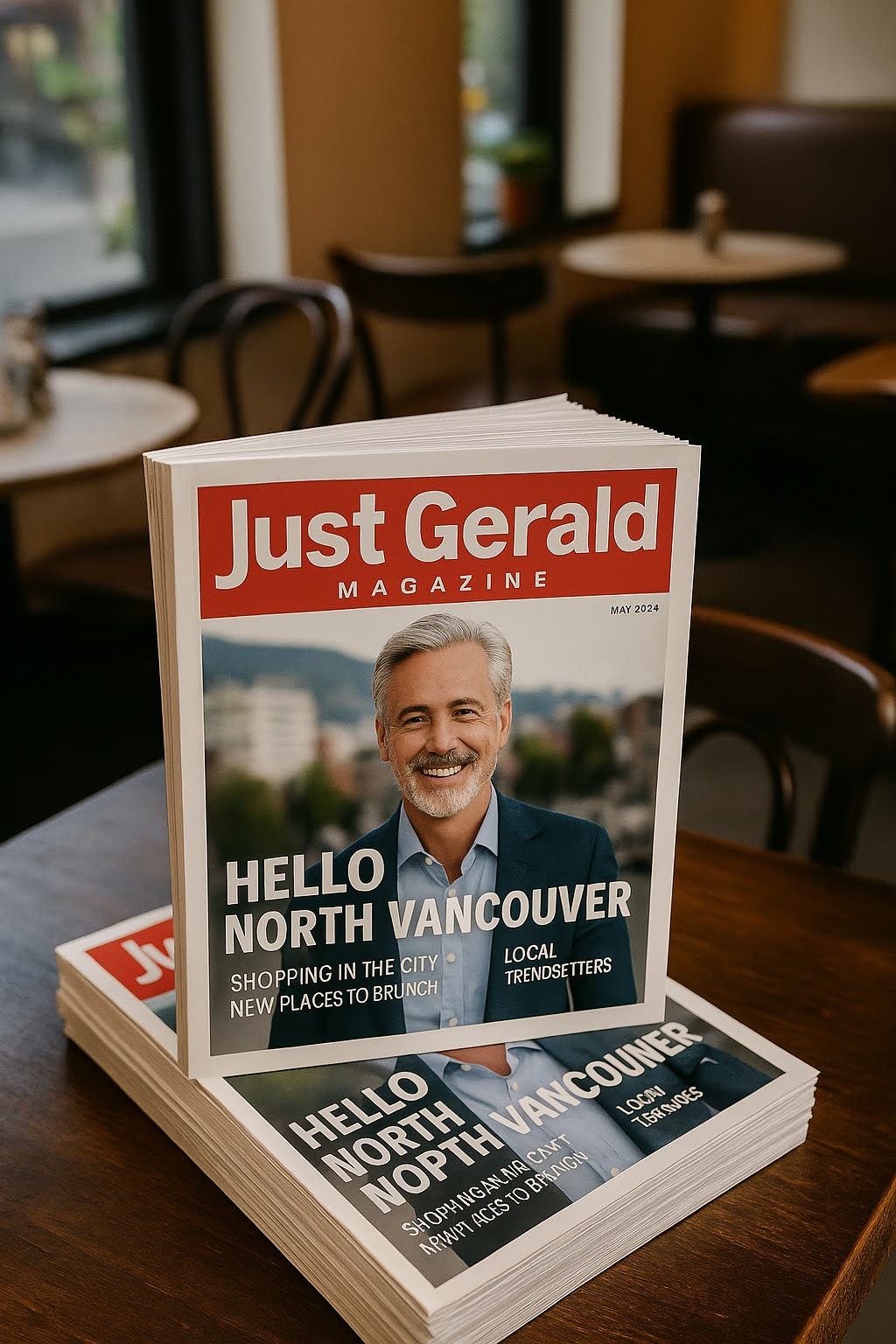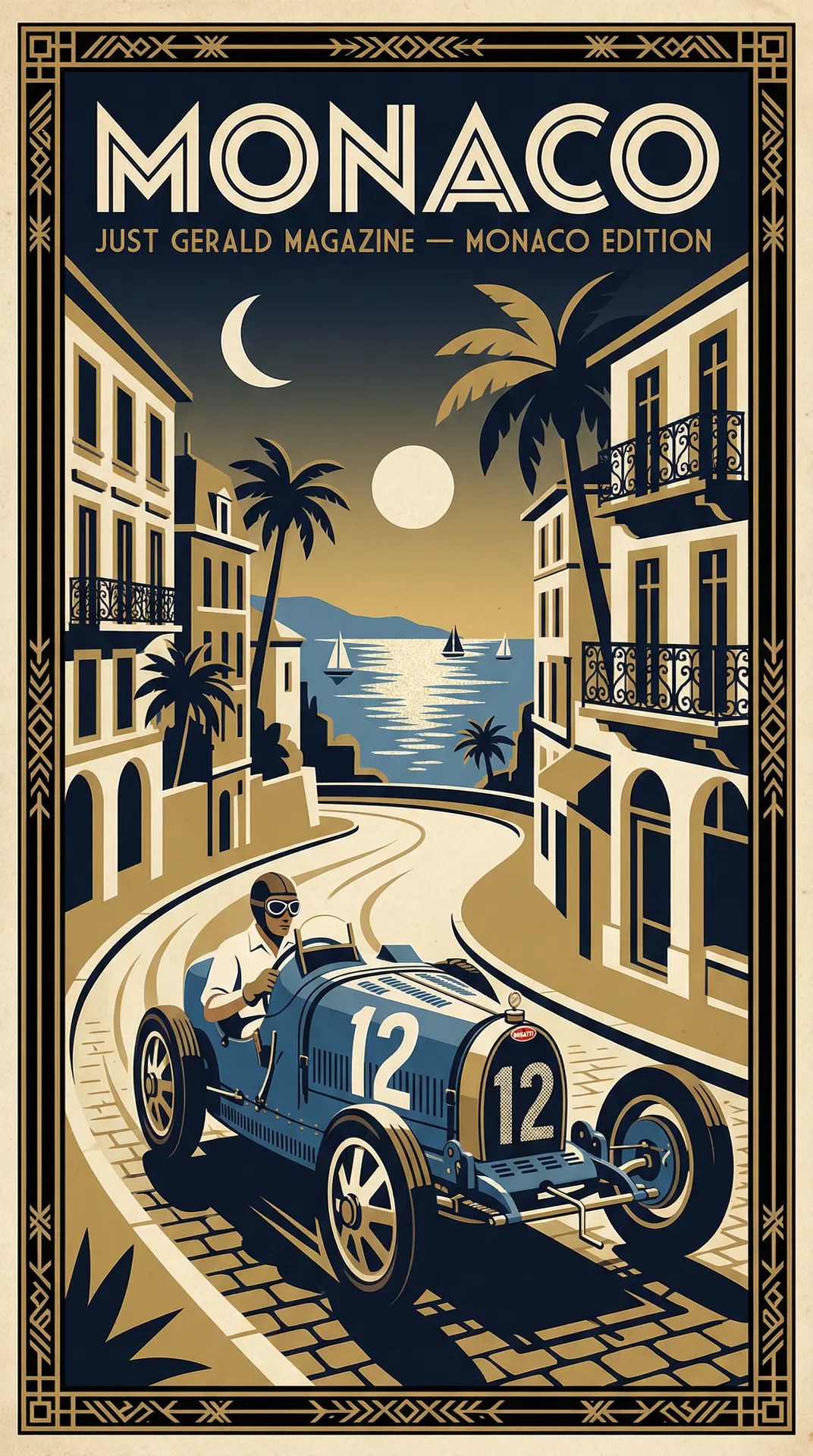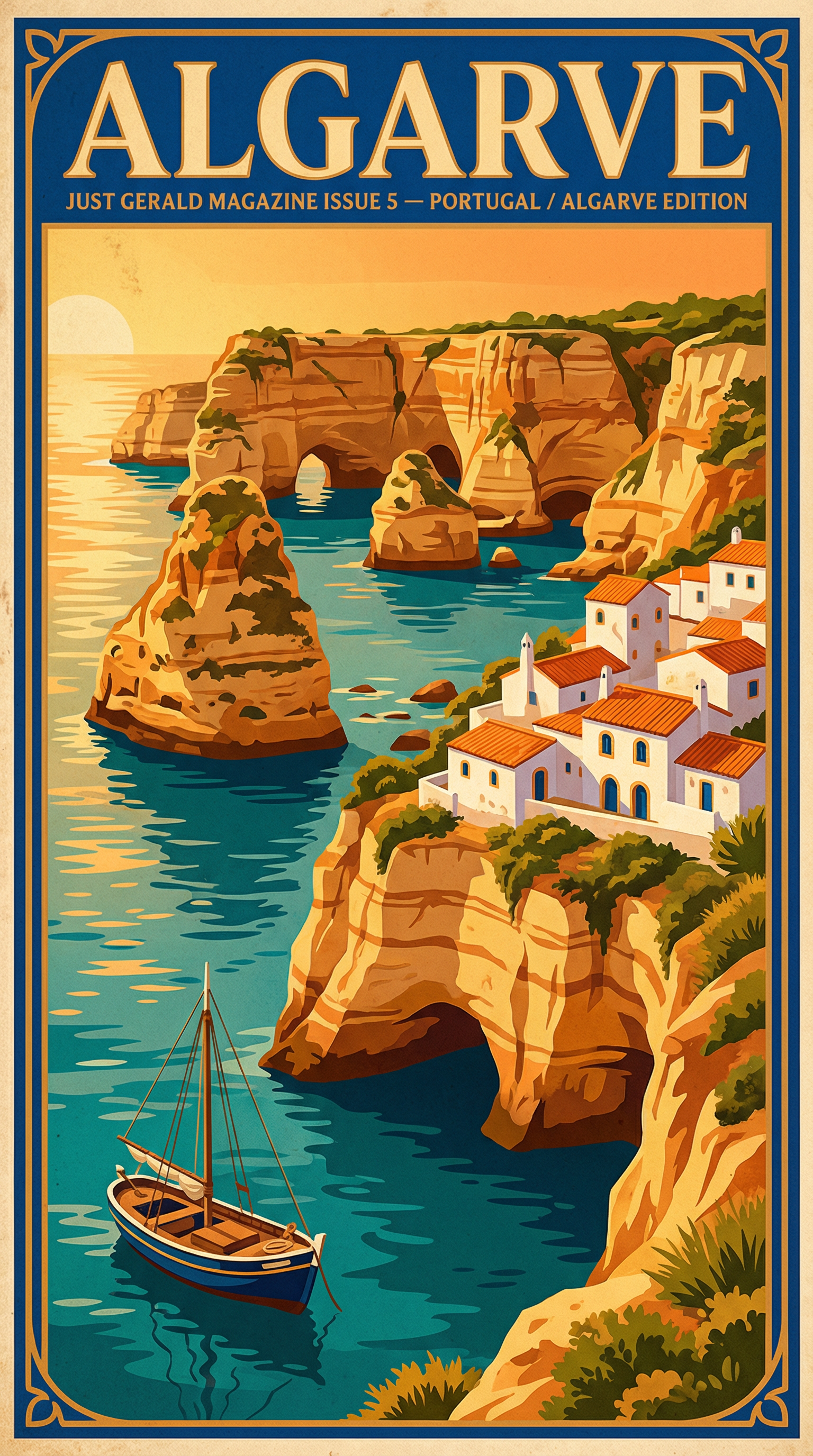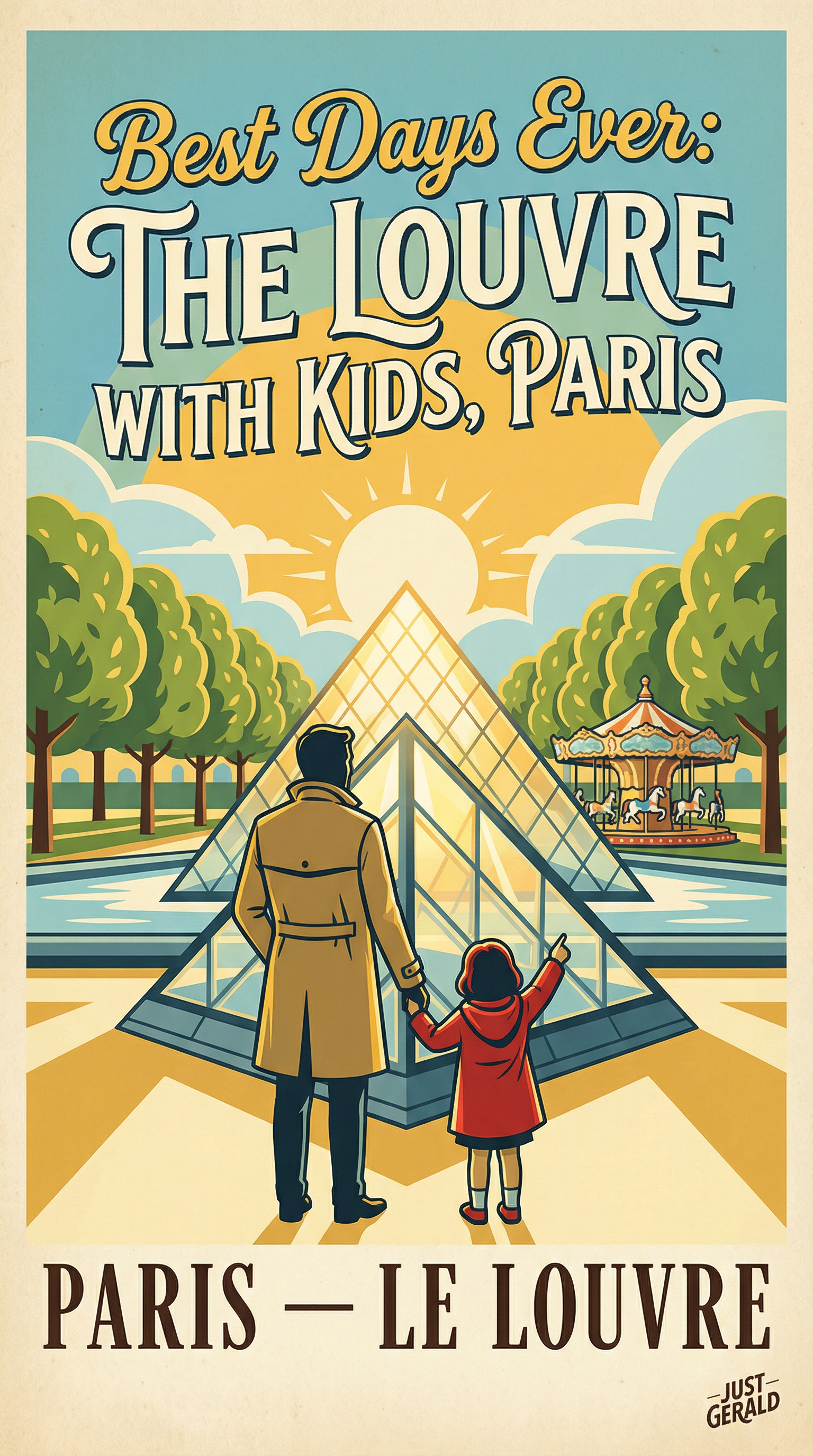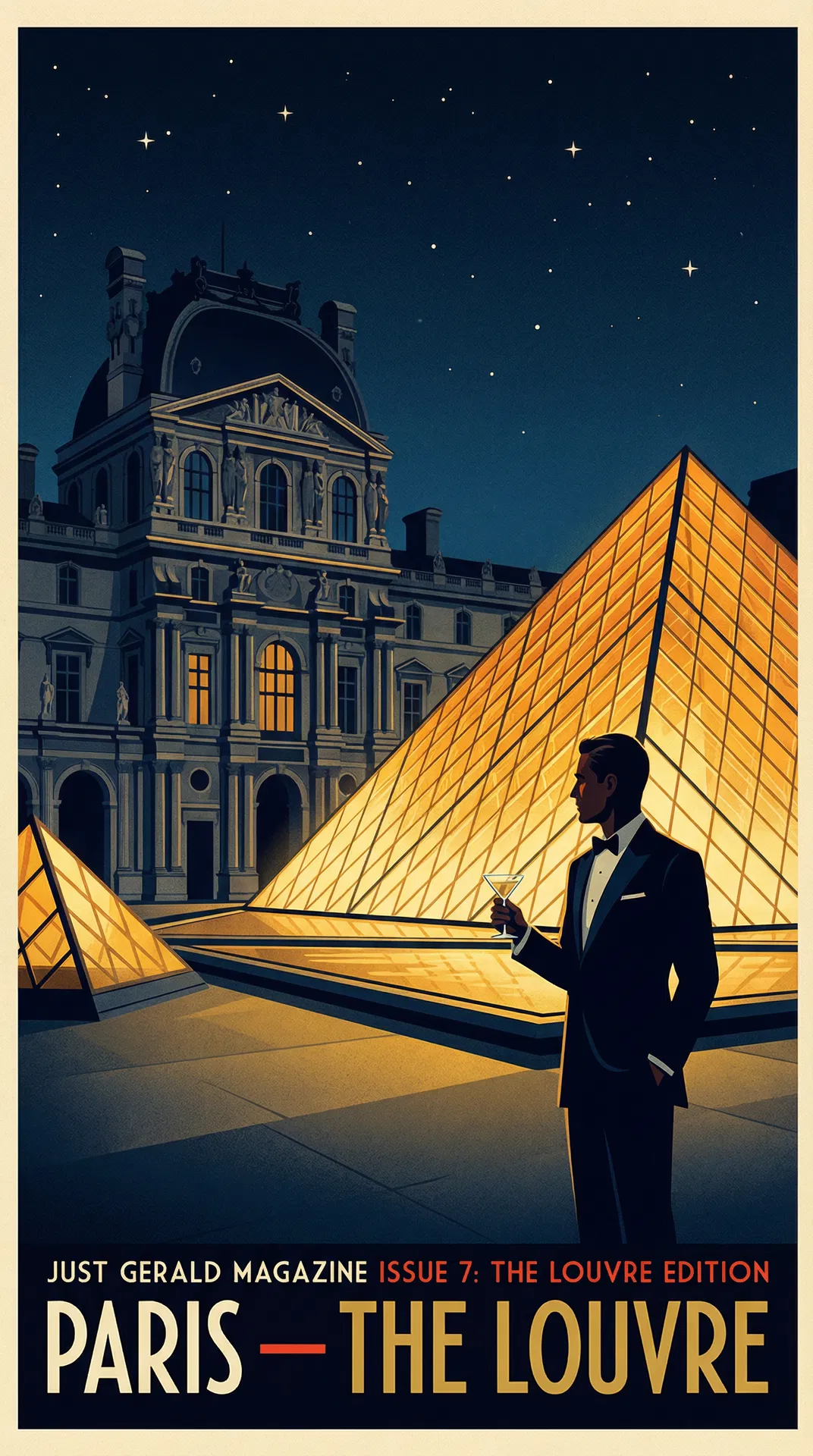
Just Gerald Magazine Issue 7 — The Louvre Edition
Best Days EverParis Edition

THE

LOUVRE

The pyramid, the Winged Victory, the wine bar behind the Palais Royal, and the most famous hotel bar in the world.

1ARCHITECTURE
1MUSEUM GUIDE
1COFFEE
1DINING
1NEIGHBOURHOOD
1WINE
1COCKTAILS
1CULTURE
1BEST DAY EVER
Issue07

About This Issue

"The Louvre has 72,735 square metres of gallery space. If you spent thirty seconds in front of every work on display, you would need four months. Gerald has done the work so you don't have to."

Issue 7 takes Just Gerald to the 1st arrondissement of Paris — specifically to the Louvre and the extraordinary neighbourhood that surrounds it. We stand beneath I.M. Pei's pyramid and consider the audacity. We climb the Daru staircase to the Winged Victory. We eat lunch on the Loulou terrace with the Eiffel Tower in the distance. We drink natural wine in a candlelit cellar behind the Palais Royal. And we end the day at Bar Hemingway, where Colin Field makes us something we didn't know we needed. This is the Best Day Ever: Paris.

ARCHITECTURE7 min read

The Pyramid

How a glass triangle became the most controversial — and beloved — building in Paris.

In 1983, François Mitterrand commissioned a Chinese-American architect to redesign the entrance to the greatest palace in Europe. The French were furious. Forty years later, the Pyramid is as synonymous with Paris as the Eiffel Tower. Gerald stands beneath it and considers the audacity.
The Pyramid

A President's Gamble

The Louvre in 1981 was a mess. The entrance was through a side door. The signage was non-existent. The north wing was still occupied by the French Ministry of Finance. When François Mitterrand launched his Grands Travaux — his programme of monumental public architecture — the Louvre was the centrepiece. The question was what to do with it. I.M. Pei, the architect Mitterrand chose without a competition, without a shortlist, without asking anyone's opinion, proposed a glass pyramid in the centre of the Cour Napoléon. The reaction was immediate and volcanic. Le Figaro called it a 'gigantic, dark diamond.' Architects signed petitions. The press published mock-ups showing the pyramid dwarfing the palace. None of them were accurate. Pei's pyramid stands 21.6 metres tall — barely a quarter of the height of the palace's roofline.

"They showed the pyramid as if it were the size of Giza. It was propaganda, not architecture criticism."

What Pei Actually Built

The pyramid is made of 673 rhombus-shaped and 118 triangular glass panes. Pei insisted on a specific type of ultra-clear glass — low in iron, which gives ordinary glass its greenish tint — so that the palace facades would be visible through it from both inside and out. The result is a structure that is almost invisible in certain lights and blazingly present in others. Below the pyramid is the Hall Napoléon, a vast underground lobby that solved the Louvre's real problem: how to distribute 9 million visitors a year into three wings without creating a stampede. The pyramid is not decoration. It is infrastructure, brilliantly disguised as art.
Essential

The Inverted Pyramid

Fewer people know about the inverted pyramid — La Pyramide Inversée — in the Carrousel du Louvre shopping mall beneath the Tuileries. It points downward from the ceiling, its tip almost touching a small stone pyramid on the floor. Conspiracy theorists have had a field day with it. Dan Brown made it the climax of The Da Vinci Code. The reality is more prosaic: it is a skylight, designed to bring natural light into the underground mall. But it is extraordinary to stand beneath it and look up through the glass into the sky above the Cour Napoléon.

How to See It

The pyramid is best seen at three moments: at dawn, when the glass catches the first light and the courtyard is empty; at dusk, when the interior illumination makes it glow like a lantern against the darkening stone; and at night, when the whole Cour Napoléon is lit and the pyramid becomes something genuinely otherworldly. If you are visiting the museum, enter through the pyramid. Not through the Porte des Lions, not through the Richelieu passage from the Rue de Rivoli. Through the pyramid. Stand in the Hall Napoléon and look up. Then go and see some art.

Just Gerald Says

AddressCour Napoléon, Musée du Louvre, 75001 Paris
Best time to visitDawn or dusk for the light
Inverted pyramidCarrousel du Louvre, 99 Rue de Rivoli
ArchitectI.M. Pei, completed 1989

The Verdict

The most important building in Paris since Haussmann. The controversy was the point — it proved the palace was still alive.

MUSEUM GUIDE12 min read

What to Actually See

A ruthlessly edited guide to the Louvre’s 35,000 works on display — and the 580,000 you can safely ignore.

The Louvre has 72,735 square metres of gallery space. If you spent thirty seconds in front of every work on display, you would need four months. Gerald has done the work so you don't have to. Here is what matters.
What to Actually See

The Denon Wing: Where the Crowds Go

The Denon Wing is the most visited part of the Louvre and the most exhausting. It contains the Mona Lisa, the Wedding at Cana, the Winged Victory of Samothrace, and the Venus de Milo. It also contains approximately eight thousand people at any given moment between 9am and 6pm. The Mona Lisa is smaller than you expect — 77 by 53 centimetres — and further away than you'd like, behind bulletproof glass, across a rope barrier, with a hundred phones in front of it. The painting is extraordinary. The experience of seeing it is not. Go early, go fast, and don't let it be the reason you came. The Winged Victory of Samothrace, at the top of the Daru staircase, is a different proposition entirely. She is enormous — over two metres tall — and she is headless, and she is the most thrilling thing in the building. Stand at the bottom of the staircase and look up at her. She has been standing there since 190 BC, on the prow of a ship, facing into the wind. She still looks like she's moving.

"The Mona Lisa is extraordinary. The experience of seeing it is not. Go early, go fast."

Essential

The Richelieu Wing: Where the Connoisseurs Go

The Richelieu Wing is the former home of the French Ministry of Finance, vacated in 1989 when the Grand Louvre project was completed. It is the least visited wing and the most rewarding. The Dutch and Flemish paintings — Vermeer, Rembrandt, Rubens — are here, in rooms that are never crowded. The French sculpture courts, with their glass roofs and their monumental stone figures, are among the most beautiful spaces in Paris. The Richelieu also contains the apartments of Napoleon III — the actual rooms where the Emperor received guests, still furnished, still gilded, still absurd in their magnificence. They are free to enter with your museum ticket and almost nobody goes.
Essential

The Sully Wing: The Oldest Part

The Sully Wing contains the medieval foundations of the original Louvre fortress — the moat, the keep, the towers — visible through glass floors in the basement. It also contains the Egyptian antiquities, which are among the finest outside Cairo, and the Greek and Roman sculpture, including the Venus de Milo. The Venus de Milo is in the Salle de la Vénus on the ground floor of the Sully Wing. She is less crowded than the Mona Lisa, more beautiful, and more mysterious — no one knows who made her, when exactly, or what her missing arms were doing. She has been in Paris since 1821. She has never looked like she belongs anywhere else.
Recommended

The Islamic Art Galleries

The Islamic Art galleries, opened in 2012 under a spectacular undulating gold roof in the Cour Visconti, are the newest addition to the Louvre and among the most stunning. The collection spans 1,300 years and three continents — carpets from Persia, tiles from Anatolia, astrolabes from Andalusia, manuscripts from Mughal India. Almost no one goes. On a busy Saturday, you can have the entire space to yourself.

Just Gerald Says

LocationCour Visconti, Denon Wing, Ground Floor
ArchitectMario Bellini & Rudy Ricciotti, 2012
Crowd levelMinimal — a genuine secret
HighlightThe Baptistère de Saint Louis, 14th-century Syrian metalwork

The Practical Matters

Buy tickets online. Always. The queue at the pyramid for walk-in tickets can be two hours. Online tickets allow you to go directly through the security line, which is usually fifteen minutes. The Louvre is free on the first Friday evening of every month, from 6pm to 9:45pm, for visitors under 26. It is also free for EU residents under 26 at all times. The museum is closed on Tuesdays. The best time to visit is Wednesday or Friday evening, when the museum stays open until 9:45pm. The crowds thin dramatically after 5pm. The Winged Victory at dusk, with the light coming through the windows of the Daru staircase, is one of the great experiences Paris offers.

Just Gerald Says

Opening hoursMon, Thu, Sat, Sun: 9am–6pm. Wed & Fri: 9am–9:45pm. Closed Tuesday.
Tickets€22 online. Free under 18. Free EU residents under 26.
Best entryThrough the Pyramid. Always.
Audio guide€5. Worth it for the Denon Wing highlights.

The Verdict

Give it a full day. Come back for the evening opening. The Louvre rewards patience and punishes rushing.

Advertise in Issue 7
C

Coffee Roaster — Paris 1er

Café Verlet

"Roasting since 1880. The best espresso in the 1st."

256 Rue Saint-Honoré, 75001

COFFEE5 min read

Café Verlet

The best coffee in the 1st arrondissement, and one of the best in Paris.

On the Rue Saint-Honoré, a five-minute walk from the Louvre, there is a coffee shop that has been roasting its own beans since 1880. It smells like the nineteenth century. The coffee tastes like the future.
Café Verlet

The Room

Café Verlet occupies a narrow shopfront on the Rue Saint-Honoré, its window stacked with burlap sacks of green coffee and glass jars of roasted beans. Inside, the room is small — perhaps ten tables — with dark wood panelling, a marble counter, and the smell of freshly ground coffee so intense it is almost a physical presence. It has looked like this, more or less, since 1920.

The Coffee

Verlet roasts its own beans, sourced from small producers across Ethiopia, Yemen, Guatemala, and Colombia. The espresso is exceptional — dense, complex, with a finish that lingers. The filter coffee, served in a small pot at the table, is even better. They also sell beans to take home, and the staff will grind them to your specification. This is not a third-wave coffee shop with exposed concrete and a playlist. It is a Parisian institution that has been doing the same thing for 145 years and sees no reason to change.

"It has looked like this, more or less, since 1920. The coffee tastes like it has been perfected over the same period."

Essential

When to Go

Go before the Louvre, not after. You will want to be alert for the Winged Victory. The café opens at 9am and the morning rush is between 8:30 and 10am. If you arrive at 9am on a weekday, you will usually find a table. On weekends, arrive early or expect to wait.

Just Gerald Says

Address256 Rue Saint-Honoré, 75001 Paris
HoursMon–Sat: 9am–6:30pm. Closed Sunday.
OrderEspresso or filter coffee. Both exceptional.
Also buyBeans to take home. The Yemen Mocha is extraordinary.

The Verdict

The best pre-Louvre coffee in Paris. Non-negotiable.

DINING6 min read

Loulou

Lunch inside the Louvre, with a view of the Tuileries and the Eiffel Tower.

Loulou is inside the Musée des Arts Décoratifs, which is technically inside the Louvre complex. It has a terrace that looks across the Tuileries garden to the Eiffel Tower. The food is Italian and surprisingly good. The view is unreasonable.
Loulou

The Setting

The Musée des Arts Décoratifs occupies the Rohan wing of the Louvre, facing the Tuileries. Loulou is on the ground floor, with a terrace that extends into the garden. In summer, the terrace is one of the finest places to eat lunch in Paris — the Eiffel Tower visible in the distance, the chestnut trees of the Tuileries overhead, the hum of the city somewhere beyond. In winter, the interior is warm and candlelit and perfectly pleasant.

The Food

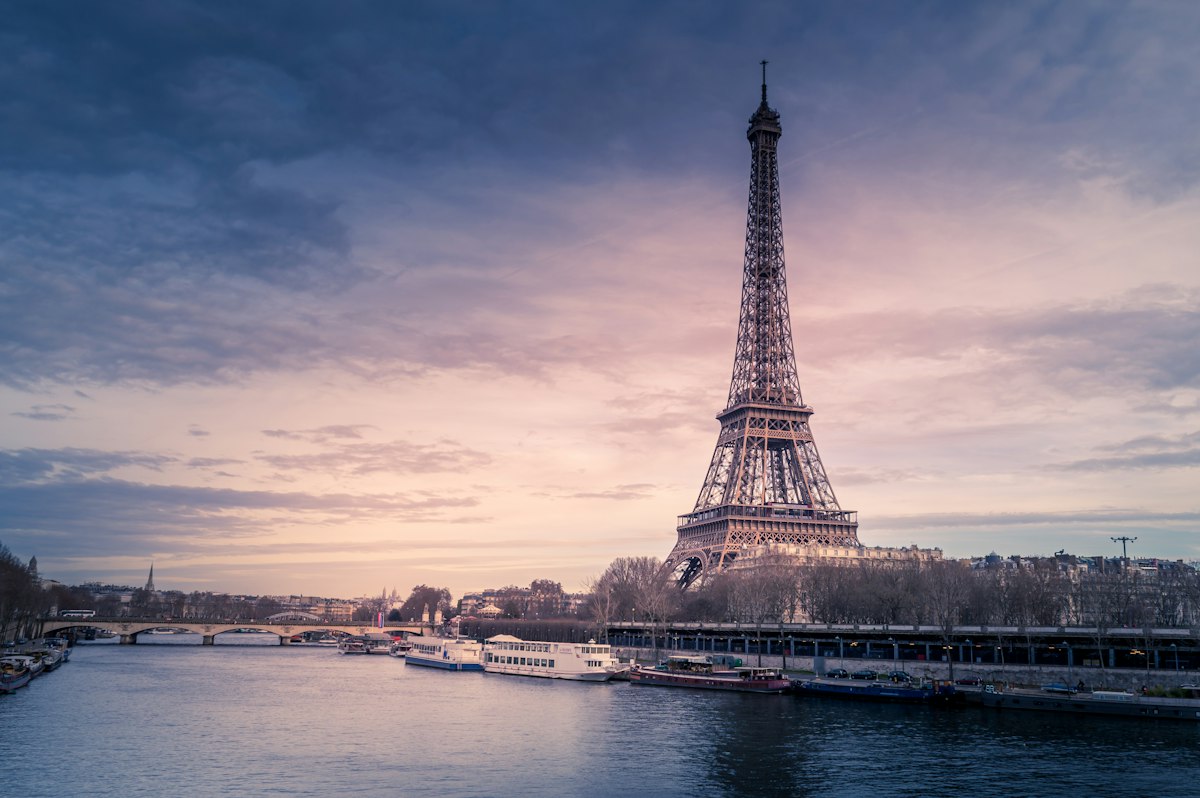
The menu is Italian — antipasti, pasta, pizza, a few secondi. The artichoke salad is excellent. The small pizzas are better than they have any right to be at a museum restaurant. The pasta is reliable. The veal chop is passable but not the reason to come. The wine list is short but well chosen, with a good selection of Italian bottles at prices that are high but not outrageous for the location. The Vermentino by the glass is the correct order.

"The food isn't why you come to Loulou. But it's good enough that you won't mind."

Recommended

The Practical Matters

Loulou is popular. Book a table for lunch, especially on weekends and in summer. The terrace fills up by 12:30pm. If you cannot get a reservation, the bar inside serves the full menu and is usually easier to access. You do not need a museum ticket to eat at Loulou — enter through the Rue de Rivoli entrance to the Musée des Arts Décoratifs and tell them you have a reservation.

Just Gerald Says

Address107 Rue de Rivoli, 75001 Paris (inside Musée des Arts Décoratifs)
HoursDaily 12pm–11pm
ReservationsEssential for terrace. Book at least 3 days ahead.
OrderArtichoke salad, small pizza, Vermentino by the glass.

The Verdict

The best lunch in the Louvre complex. The terrace in summer is one of the great Paris experiences.

Advertise in Issue 7
V

Wine Bar & Restaurant — Paris 1er

Verjus

"Natural wine. Candlelit cellar. Behind the Palais Royal."

47 Rue de Montpensier, 75001

NEIGHBOURHOOD8 min read

The Palais Royal

The most beautiful garden in Paris that nobody talks about.

Two minutes from the Louvre, through an archway off the Rue de Rivoli, there is a garden that most tourists walk past without knowing it exists. It is enclosed on three sides by arcaded galleries containing some of the most interesting shops and restaurants in Paris. It is also the place where the French Revolution began.
The Palais Royal

The History

The Palais Royal was built in 1634 for Cardinal Richelieu, who left it to the Crown on his death. It passed to the Orléans family in 1692, and it was the Duc d'Orléans who, in 1780, built the arcaded galleries around the garden and rented them out to shops, cafés, and theatres. The Palais Royal became the most fashionable address in Paris — a place to shop, to drink, to gamble, and to discuss politics. On 12 July 1789, a young journalist named Camille Desmoulins stood on a café table in the Palais Royal garden and called the crowd to arms. Two days later, the Bastille fell. The French Revolution began in a garden.

"The French Revolution began in a garden. It seems appropriate."

The Colonnes de Buren

In 1986, the artist Daniel Buren installed 260 black-and-white striped columns of varying heights in the main courtyard of the Palais Royal. The reaction was, predictably, volcanic. Jack Lang, the Culture Minister, called them 'a masterpiece.' The press called them 'a scandal.' The columns are still there. Children play on them. Tourists photograph them. They have become, like the Pyramid, an essential part of the place they were supposed to desecrate.
Essential

The Galleries

The arcaded galleries that surround the garden contain an extraordinary mix of shops — antique toy soldiers, vintage stamps, specialist chess sets, a shop that sells only music boxes, a shop that sells only tin soldiers, a shop that sells only antique medals. There are also restaurants, including Le Grand Véfour, which has been serving food under the same painted ceiling since 1784 and holds two Michelin stars. The galleries are covered and therefore dry in the rain. They are also cool in summer. They are one of the great places to walk in Paris at any time of year.

Just Gerald Says

AddressPlace du Palais-Royal, 75001 Paris
Garden hoursDaily 7am–11pm (summer) / 7am–8:30pm (winter)
EntryFree
Don't missColonnes de Buren, Le Grand Véfour, Café Kitsuné

Café Kitsuné

At the northern end of the Palais Royal gardens, in the arcaded gallery, is Café Kitsuné — the coffee shop of the Japanese fashion brand, opened in a former bookshop. The coffee is excellent, the pastries are exceptional, and the setting — looking out over the garden through the stone arches — is perfect. It is the correct place to sit after the Louvre and before dinner.
Essential

The Verdict

The best hour you will spend in Paris that isn't inside a museum. Go in the afternoon, when the light comes through the arcades.

WINE6 min read

Verjus

The wine bar behind the Palais Royal that changed how Paris drinks.

Verjus opened in 2011 in a narrow passage behind the Palais Royal and immediately became the most influential wine bar in Paris. It is still the best. Gerald orders the natural wine list and considers the question of whether Paris has finally caught up with its own vineyards.
Verjus

The Room

Verjus Bar à Vins is in the basement of the Verjus restaurant, down a narrow staircase, in a vaulted stone cellar. It is small — perhaps twenty seats — and candlelit and quiet in a way that Paris wine bars rarely are. The walls are stone. The wine list is a book.

The Wine

The list at Verjus is one of the finest in Paris — natural wines, biodynamic wines, and a selection of classic Burgundies and Bordeaux that would embarrass most dedicated wine restaurants. The American owners, Braden Perkins and Laura Adrian, built the list with the same rigour they applied to the restaurant upstairs, which holds a Michelin star. The correct approach is to ask the sommelier what they are excited about. The answer changes weekly. On a recent visit, the answer was a Jura Savagnin from a producer who makes fewer than 2,000 bottles a year. It was one of the best glasses of wine Gerald has had in Paris.

"Ask the sommelier what they are excited about. The answer changes weekly and is always worth following."

Essential

The Food

Verjus Bar à Vins serves small plates — charcuterie, cheese, a few cooked dishes that change with the season. The food is excellent and designed to complement the wine rather than compete with it. The cheese selection is exceptional.

Just Gerald Says

Address47 Rue de Montpensier, 75001 Paris
HoursMon–Sat: 6pm–midnight. Closed Sunday.
ReservationsWalk-in only for the wine bar. Book ahead for the restaurant.
OrderWhatever the sommelier recommends. Trust them.

The Verdict

The best wine bar in the 1st arrondissement. One of the best in Paris. Go after the Palais Royal, before dinner.

Advertise in Issue 7
B

Hotel Bar — Paris 1er

Bar Hemingway

"The most famous bar in Paris. Dress accordingly."

Hôtel Ritz, 15 Place Vendôme, 75001

COCKTAILS7 min read

Bar Hemingway

The most famous hotel bar in the world. Gerald orders a Serendipity and considers the mythology.

The Ritz Paris is on the Place Vendôme, a ten-minute walk from the Louvre. In its basement is a bar named after Ernest Hemingway, who allegedly liberated it from the Germans in August 1944 with a group of irregular fighters and immediately ordered dry martinis. The bar is presided over by Colin Field, who has been making cocktails here since 1994 and is considered by many to be the finest bartender in the world. Gerald tests the hypothesis.
Bar Hemingway

The Room

Bar Hemingway is small — perhaps fifteen seats at the bar, a few leather armchairs along the wall. The walls are covered in photographs and memorabilia relating to Hemingway's time in Paris. The lighting is low. The atmosphere is one of concentrated, expensive pleasure. It is one of those rooms that makes you feel that the world outside does not exist.

Colin Field

Colin Field has been the head bartender at Bar Hemingway since 1994. He is English, which is either ironic or appropriate depending on your view of the French. He is also, by any measure, extraordinary at his job. His cocktails are built around a concept he calls 'emotional bartending' — the idea that a good bartender reads the customer and makes them something that fits their mood rather than their order. The Serendipity — champagne, fresh lemon juice, and a secret ingredient that Field will not disclose — is the signature cocktail. It is light, precise, and slightly addictive. The Clean Dirty Martini, made with vodka or gin and a proprietary olive brine, is the other essential order.

"A good bartender reads the customer and makes them something that fits their mood rather than their order."

Essential

The Mythology

The Hemingway story — the liberation, the dry martinis — is probably apocryphal. Hemingway himself told it in several different versions, with the number of martinis ranging from three to fifty-one. The Ritz has leaned into the mythology with enthusiasm. The bar is named after him, the walls are covered in his photographs, and the menu references his novels. None of this matters. The cocktails are real. The room is real. The experience of sitting at the bar while Colin Field makes you something you didn't know you needed is real.

Just Gerald Says

Address15 Place Vendôme, 75001 Paris
HoursDaily 6pm–2am
Dress codeSmart. This is the Ritz.
OrderThe Serendipity or the Clean Dirty Martini. Ask Colin what he recommends.
Price€30–€45 per cocktail. Worth it once.

The Verdict

The most famous bar in Paris. The mythology is earned. Go once, dressed properly, and order whatever Colin Field suggests.

CULTURE6 min read

Sainte-Chapelle

The most beautiful room in Paris is not in the Louvre.

A fifteen-minute walk from the Louvre, on the Île de la Cité, is a Gothic chapel built in 1248 to house the Crown of Thorns. The upper chapel has fifteen windows, each fifteen metres tall, containing 1,113 scenes from the Old and New Testaments in stained glass. On a sunny day, the light inside is indescribable.
Sainte-Chapelle

The Building

Sainte-Chapelle was built by Louis IX — Saint Louis — in seven years, completed in 1248. The speed of construction was remarkable; the engineering was revolutionary. The walls are almost entirely glass, held in place by a skeleton of stone so slender it seems impossible. The architects of the thirteenth century understood something about structural engineering that we still find astonishing: that you can build a room of glass if the stone is in exactly the right places.

The Upper Chapel

The lower chapel is fine — painted in red and gold, low-ceilinged, used by the palace servants. The upper chapel is one of the great rooms in the world. The windows begin at floor level and rise fifteen metres to the vaulted ceiling. The light, on a clear day, is coloured — blue and red and gold — and it moves across the floor as the sun moves across the sky. The effect is of being inside a jewel. The windows tell the story of the Bible from Genesis to the Apocalypse, reading from left to right, bottom to top. You do not need to read them to feel their effect. You need only to stand in the room and look up.

"The effect is of being inside a jewel. On a sunny day, the light inside is indescribable."

Essential

The Practical Matters

Sainte-Chapelle is on the Île de la Cité, inside the Palais de Justice complex. You will go through security. The queue can be long in summer — arrive early or book tickets online. The chapel is small and fills quickly. The best time to visit is a sunny morning, when the light comes through the east windows. The worst time is a grey afternoon, when the windows lose their luminosity. Check the weather before you go.

Just Gerald Says

Address8 Boulevard du Palais, 75001 Paris
HoursDaily 9am–5pm (winter) / 9am–7pm (summer)
Tickets€13. Book online to skip the queue.
Best timeSunny morning. The east windows are extraordinary in early light.
Combined ticketAvailable with Conciergerie for €20.

The Verdict

The most beautiful room in Paris. Go on a sunny day. Nothing else in the city compares.

Advertise in Issue 7
L

Restaurant — Paris 1er

Loulou

"Italian food. Tuileries terrace. Eiffel Tower view."

107 Rue de Rivoli, 75001

BEST DAY EVER10 min read

Best Day Ever: The Louvre

From the first coffee to the last cocktail — the perfect day in the 1st arrondissement.

The 1st arrondissement is the oldest part of Paris and, on the right day, the best. Here is how Gerald does it: from the first espresso on the Rue Saint-Honoré to the last cocktail at the Ritz, with the Winged Victory and the Palais Royal gardens in between.
Best Day Ever: The Louvre

8:45am — Café Verlet

Start at Café Verlet on the Rue Saint-Honoré. Order an espresso and a croissant. The croissant is from a bakery two doors down; Verlet doesn't bake but they don't mind if you bring one in. Sit at the marble counter and read the paper. This is Paris. Take your time.
Essential

9:30am — The Pyramid

Walk to the Louvre. Enter through the Pyramid. Stand in the Hall Napoléon and look up through the glass at the palace above. This is the correct way to arrive. You have a ticket — you bought it online, because you are not an amateur.

9:45am — The Winged Victory

Go directly to the Daru staircase in the Denon Wing. The Winged Victory of Samothrace is at the top. Stand at the bottom and look up. She is headless, armless, and two thousand years old. She is the most thrilling thing in the building. Spend twenty minutes here before the crowds arrive.
Essential

10:15am — The Islamic Art Galleries

Walk to the Cour Visconti and the Islamic Art galleries. Almost no one is here. The gold undulating roof is extraordinary. Spend an hour in rooms that feel like a different museum entirely.

11:30am — The Richelieu Wing

Take the stairs to the Richelieu Wing and the French sculpture courts. The glass-roofed courtyards are among the most beautiful spaces in the building. The Napoleon III apartments are on the first floor — go through them. They are absurd and magnificent.
Recommended

1:00pm — Loulou

Exit the Louvre through the Musée des Arts Décoratifs entrance on the Rue de Rivoli. Loulou is on the ground floor. You have a reservation — you made it three days ago. Order the artichoke salad, a small pizza, and a glass of Vermentino. Eat on the terrace if it is warm. The Eiffel Tower is visible in the distance. This is fine.
Recommended

2:30pm — The Palais Royal

Walk through the Rue de Rivoli archway into the Palais Royal. Spend an hour in the gardens and the arcaded galleries. Look at the Colonnes de Buren. Find the shop that sells only antique tin soldiers. Sit by the fountain. This is what Paris is for.
Essential

4:00pm — Café Kitsuné

At the northern end of the Palais Royal galleries, order a coffee at Café Kitsuné. Sit in the arcade and watch the garden. This is the best hour of the day.
Essential

5:30pm — Sainte-Chapelle (optional)

If you have energy, walk fifteen minutes to the Île de la Cité and Sainte-Chapelle. The late afternoon light through the west windows is extraordinary. This adds an hour to the day but is worth it.

6:30pm — Verjus

Walk back to the Palais Royal and down the Rue de Montpensier to Verjus Bar à Vins. Order whatever the sommelier recommends. Eat cheese. Drink wine. This is the transition between the day and the evening.
Essential

9:00pm — Bar Hemingway

Walk to the Place Vendôme. Enter the Ritz. Go downstairs to Bar Hemingway. Order the Serendipity. Talk to Colin Field if he is behind the bar. This is the end of the day. It is a good end.

"This is the end of the day. It is a good end."

Essential

Just Gerald Says

Total walkingApproximately 6km
Total cost (per person)€120–€180 including museum entry, lunch, wine, and cocktails
Best seasonSpring or autumn. Summer is crowded; winter is fine but cold.
What to wearComfortable shoes. Smart for the Ritz in the evening.

The Verdict

The 1st arrondissement rewards the prepared visitor. Book the Louvre tickets, book Loulou, and let the rest happen. It will.

From the Newsstand

More Best Days Ever