Route des Grandes Alpes
ROAD TRIP EDITION

Issue 11 · Haute-Savoie à la Côte d'Azur

Best Days on the Road

Route des Grandes Alpes

700 kilometres. 16 mountain passes. One Citroën DS. No hurry.

THE DRIVE7 min

La Route

The road that connects the Alps to the Mediterranean, one pass at a time
La Route

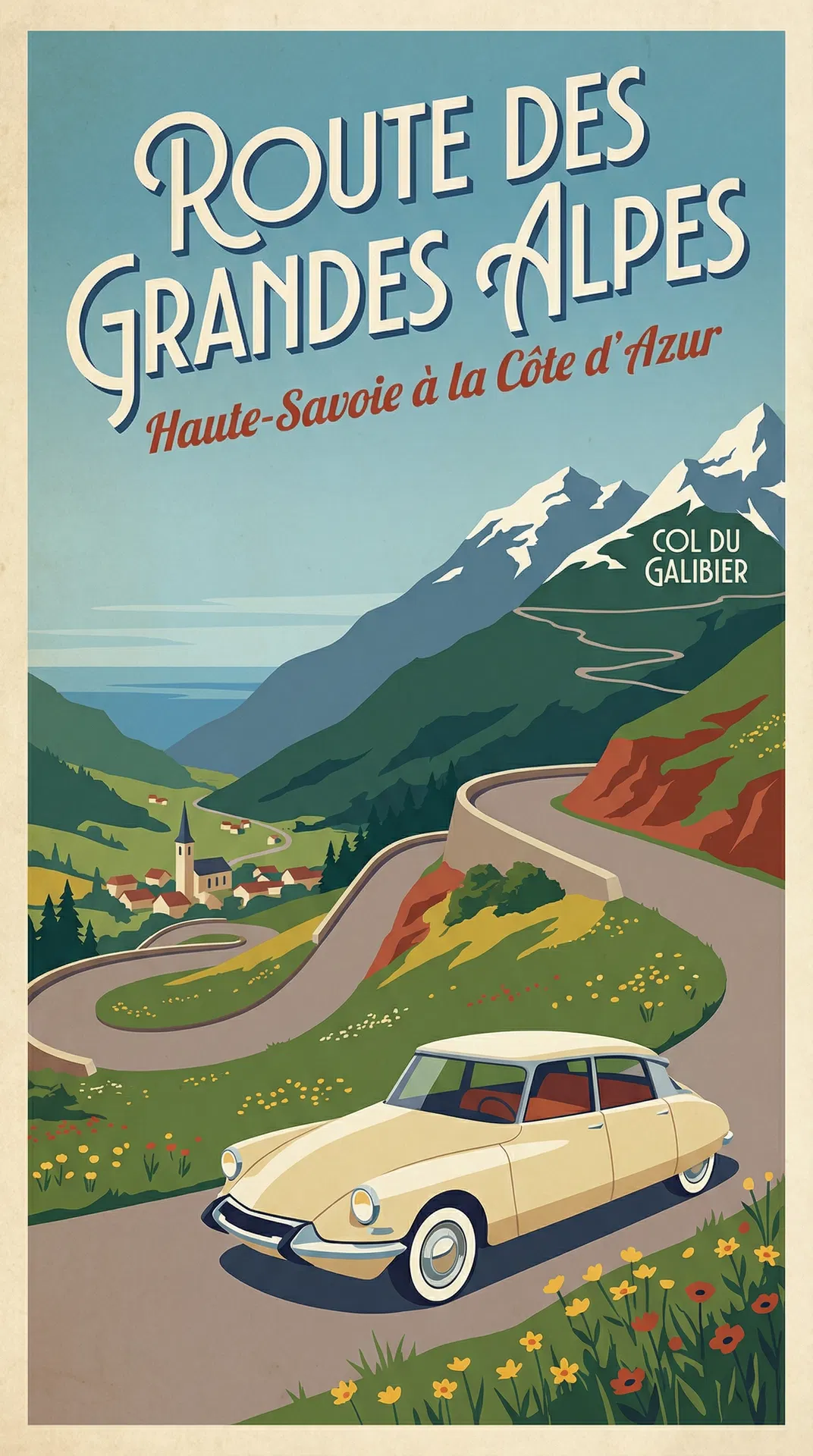
"The route crosses 16 mountain passes. The Col du Galibier, at 2,642 metres, is the highest paved road in France. The view from the top is worth the climb."

The Route des Grandes Alpes was conceived in 1909 by the Touring Club de France as a scenic route linking the Alps to the Mediterranean. It runs from Thonon-les-Bains on the shore of Lake Geneva to Menton on the French Riviera — approximately 700 kilometres through the French Alps, crossing 16 mountain passes and climbing through some of the most dramatic mountain scenery in Europe.

The route passes through Haute-Savoie, Savoie, Isère, Hautes-Alpes, Alpes-de-Haute-Provence, and Alpes-Maritimes — six departments, each with its own character, its own food, and its own relationship with the mountains. In the north, the landscape is green and forested, the villages are Savoyard, and the food is built around cheese and cream. In the south, the landscape opens into lavender fields and limestone plateaux, the villages are Provençal, and the food shifts toward olive oil, herbs, and rosé.

The highest point is the Col du Galibier, at 2,642 metres — the highest paved road in France and one of the most celebrated climbs in the Tour de France. The Galibier has featured in the Tour more than 60 times since 1911. The memorial to Henri Desgrange, the founder of the Tour, stands at the summit. The view from the top — the Écrins massif to the south, the Mont Blanc massif to the north — is one of the great mountain panoramas in Europe.

The route is typically open from June to October. Several of the high passes — including the Galibier and the Col de l'Iseran — are closed by snow from November to May. The ideal time to drive it is late June, when the passes have just opened and the wildflower meadows are at their peak, or early September, when the summer crowds have thinned and the light has the particular quality of early autumn in the mountains.

Just Gerald's recommendation: drive it south, from Thonon to Menton. The passes are more dramatic when you approach them from the north, and arriving at the Mediterranean after days in the mountains is one of the great travel experiences — the moment when the road finally descends through the last limestone gorge and the sea appears, blue and flat and impossibly warm.

Essential

Just Gerald Says

The route is free to drive. The Col du Galibier charges nothing. The only cost is time — allow five days minimum, seven if you want to stop properly.
THE STOPS5 min

Annecy

The lake town that earns every superlative thrown at it

Annecy

"Lake Annecy is the cleanest lake in Europe. The water is so clear that you can see the bottom at ten metres depth."

Annecy sits at the northern end of Lake Annecy, 35 kilometres south of Geneva, and is one of the most beautiful towns in France. This is not a controversial claim. The old town — a medieval warren of canals, arcaded streets, and geranium-hung bridges — is genuinely extraordinary, and the lake behind it, ringed by mountains, is the cleanest in Europe.

The town has been drawing visitors since the 19th century, when it became a fashionable destination for the Savoyard aristocracy and later for the Parisian bourgeoisie. The result is a town that knows how to feed and house visitors without losing its own character — a balance that many beautiful French towns have failed to maintain.

Le Clos des Sens (13 rue Jean-Mermoz, Annecy-le-Vieux) is a two-Michelin-star restaurant run by Laurent Petit, who has built his menu around the produce of the lake and the surrounding mountains. The lake fish — féra, omble chevalier, perch — are the centrepiece. The tasting menu is long and exceptional. Book months in advance.

Café de la Brasserie (17 rue Sainte-Claire) is the correct alternative: a proper French brasserie on the main arcaded street of the old town, serving onion soup, steak frites, and local Savoyard wine. The terrace looks onto the canal. The wine list is short and honest.

La Maison de Marc Veyrat — the legendary chef who grew up in the mountains above Annecy and built his cuisine around Alpine plants and herbs — is no longer open in its original form, but Veyrat's influence on the food of the region is everywhere. The use of local herbs, mountain flowers, and lake fish in contemporary Savoyard cooking traces directly back to him.

The lake itself: swim in it. The water is cold and clear and the mountains are reflected in it. There are several public beaches. The Plage d'Albigny, on the eastern shore, is the best.

Essential

Just Gerald Says

Stay at the Hôtel du Palais de l'Isle (13 rue Perrière) — a small hotel in a converted 12th-century island prison in the middle of the canal. The rooms are not large. The location is unrepeatable.

Partners & Advertisers
ADVERTISE WITH JUST GERALD
Hôtel de la Chaussée
ISSUE 11

BOUTIQUE HOTEL · BRIANÇON, HAUTES-ALPES

Hôtel de la Chaussée

"Sleep at the highest city in France."

Stone walls, mountain views, and a restaurant that takes the tartiflette seriously.

Advertise in Issue 11
ADVERTISE WITH JUST GERALD
Café de la Brasserie
ISSUE 11

BRASSERIE · RUE SAINTE-CLAIRE, ANNECY

Café de la Brasserie

"Onion soup on the canal in Annecy."

The Apremont white costs almost nothing and is excellent with the food. Order it.

Advertise in Issue 11
ADVERTISE WITH JUST GERALD
Le Péché Gourmand
ISSUE 11

RESTAURANT · ROUTE DE GAP, BRIANÇON

Le Péché Gourmand

"The best table in Briançon."

After a day crossing the Galibier, you have earned a proper dinner. This is it.

Advertise in Issue 11

Spec placements — contact [email protected] to claim your space

THE PASSES5 min

The Col du Galibier

The highest paved road in France and the most celebrated climb in cycling

The Col du Galibier

"Henri Desgrange, who founded the Tour de France, wrote of the Galibier: 'O Laffrey! O Bayard! O Aravis! Before this giant, you are no more than pale and commonplace babies.'"

The Col du Galibier stands at 2,642 metres above sea level, on the border between the Savoie and Hautes-Alpes departments. It is the highest paved road in France, the highest pass on the Route des Grandes Alpes, and one of the most celebrated climbs in cycling. It has been included in the Tour de France more than 60 times since 1911, when the race first crossed it in the era of unpaved roads and single-speed bicycles.

The approach from the north — from Valloire, through the Col du Télégraphe and then the long climb to the summit — is the classic Tour de France ascent. The road climbs 1,200 metres over 18 kilometres. The gradient averages 6.9 percent. In July, when the Tour passes through, the road is lined with tens of thousands of spectators who have camped on the mountainside for days.

In June or September, when the Tour is not here, the road is quiet. The summit is cold even in summer — bring a layer regardless of the weather below. The view from the top is extraordinary: the Écrins massif to the south, the Vanoise to the east, the Mont Blanc massif to the north. On a clear day, you can see into Italy.

The memorial to Henri Desgrange stands just below the summit. Desgrange founded the Tour de France in 1903 and directed it until 1936. He was obsessed with the Galibier — he wrote about it in terms that bordered on religious. The memorial is a simple stone monument with a bronze plaque. It is worth stopping for.

The descent to the south — toward Briançon — is faster and more open than the northern approach, with long sweeping curves through a high Alpine valley. The village of Briançon, at the bottom, is the highest city in France and has a remarkable Vauban-designed fortified old town. Stop for coffee.

Essential

Just Gerald Says

The Galibier is typically open from mid-June to mid-October. Check the road conditions at viamichelin.fr before you go — the pass can close with short notice in bad weather even in summer.

FOOD & DRINK5 min

Eating in the Alps

Tartiflette, fondue, and the food that makes sense at altitude

Eating in the Alps

"Tartiflette is not a traditional Savoyard dish. It was invented in the 1980s by the Reblochon cheese producers' association to increase sales. It worked."

The food of the French Alps is built around the logic of altitude and cold. The cheeses are washed-rind and pungent — Reblochon, Beaufort, Abondance, Tomme de Savoie — because the milk from cows grazing at altitude has a richness that rewards strong treatment. The dishes are caloric and satisfying — tartiflette, fondue, raclette, gratin dauphinois — because the people who developed them were spending their days in the cold.

Tartiflette is the most famous Savoyard dish and, as the pull quote notes, the most recent. It is a gratin of potatoes, lardons, onions, and Reblochon cheese, baked until the cheese melts and browns. It is very good. It is also, at altitude after a day of driving mountain passes, exactly what you want. Every restaurant in the Alps serves it. The quality varies. The best versions use proper Reblochon — the farmhouse variety, not the industrial — and don't skimp on the lardons.

Fondue Savoyarde is the older dish and the more demanding one. A proper fondue uses a blend of Beaufort, Comté, and Gruyère, melted with white wine and a small amount of kirsch. The bread must be slightly stale — fresh bread absorbs too much cheese. The pot must be kept at the right temperature. A good fondue is a serious undertaking. The best place to eat it is a small family restaurant in a village above the snowline, where the owner has been making it for forty years.

Beaufort is the great cheese of the Alps — a hard, cooked-curd cheese made from the milk of Tarentaise and Abondance cows grazing at altitude. It has a complex, nutty flavour and a smooth texture. The summer Beaufort, made from milk of cows on the high Alpine pastures, is the finest. Buy it from a fromagerie, not a supermarket.

The wine: Savoie produces some of the most underrated wines in France. The whites — Roussette de Savoie, Apremont, Chignin — are crisp and mineral, made from local grape varieties that grow nowhere else. They are the correct wine with fondue, with fish from the lakes, with the food of the region. They are also inexpensive. Take some home.

Essential

Just Gerald Says

Fromagerie Boujon in Annecy (4 rue Sainte-Claire) is the best cheese shop on the route. The owner will cut you a piece of summer Beaufort and explain exactly where it came from. Buy more than you think you need.

Partners & Advertisers
ADVERTISE WITH JUST GERALD
Hôtel de la Chaussée
ISSUE 11

BOUTIQUE HOTEL · BRIANÇON, HAUTES-ALPES

Hôtel de la Chaussée

"Sleep at the highest city in France."

Stone walls, mountain views, and a restaurant that takes the tartiflette seriously.

Advertise in Issue 11
ADVERTISE WITH JUST GERALD
Café de la Brasserie
ISSUE 11

BRASSERIE · RUE SAINTE-CLAIRE, ANNECY

Café de la Brasserie

"Onion soup on the canal in Annecy."

The Apremont white costs almost nothing and is excellent with the food. Order it.

Advertise in Issue 11
ADVERTISE WITH JUST GERALD
Le Péché Gourmand
ISSUE 11

RESTAURANT · ROUTE DE GAP, BRIANÇON

Le Péché Gourmand

"The best table in Briançon."

After a day crossing the Galibier, you have earned a proper dinner. This is it.

Advertise in Issue 11

Spec placements — contact [email protected] to claim your space

THE DESTINATION4 min

Menton: The End of the Road

The moment the mountains give way to the Mediterranean

Menton: The End of the Road

"Menton is the last town in France before Italy. It is also the warmest town in France, sheltered by the Alps from the north wind."

The Route des Grandes Alpes ends in Menton, a small town on the French Riviera pressed between the Alps and the Mediterranean, two kilometres from the Italian border. After days in the mountains — the cold, the altitude, the vast empty landscapes — arriving in Menton is a genuine shock: the warmth, the colour, the smell of citrus and salt, the sea.

Menton is the warmest town in France. The Alps to the north block the cold mistral wind that scours the rest of the Riviera, and the town sits in a natural amphitheatre that traps the sun. The result is a microclimate that allows lemon and orange trees to grow outdoors year-round — the town's lemon festival in February is one of the most celebrated in France.

The old town — Vieille Ville — climbs steeply from the seafront in a cascade of ochre and terracotta buildings. The Basilica of Saint-Michel-Archange, at the top, has a Baroque façade and a terrace with a view over the bay that is one of the finest on the Riviera. The cemetery above the old town, where the writer Katherine Mansfield is buried, has views that justify the climb.

Mirazur (30 avenue Aristide Briand) is a three-Michelin-star restaurant run by Mauro Colagreco, an Argentine chef who has built his menu around the garden above the restaurant and the sea below it. It has been ranked the best restaurant in the world. The tasting menu is long and extraordinary. Book six months in advance.

The practical end of the road: park the car at the seafront, walk to the old town, find a table at a café on the Place aux Herbes, and order a glass of local rosé. You have driven 700 kilometres through the French Alps. The sea is in front of you. This is the correct way to finish.

Essential

Just Gerald Says

The drive from the last mountain pass — the Col de Castillon — to Menton takes about 45 minutes. Do it in the late afternoon so you arrive as the light turns golden. The descent through the gorge is spectacular.

Just Gerald — Curated Itinerary

Your Best
Day Ever

Two paths through Route des Grandes Alpes. Every decision already made. Choose your day.

Solo / Couple

8:00am

Depart Thonon-les-Bains

Thonon-les-Bains, Lake Geneva — Thonon-les-Bains, Haute-Savoie

Fill the tank and buy a croissant from the boulangerie on the main square. The route begins here, on the southern shore of Lake Geneva. The Alps are already visible ahead. Drive south.

Gerald says: The route officially starts at the Thonon-les-Bains town hall. There is a small sign. It is easy to miss.

10:00am

Annecy Old Town

Vieille Ville d'Annecy — Annecy, Haute-Savoie

The old town is extraordinary — canals, arcaded streets, the Palais de l'Isle in the middle of the water. Walk for an hour. Swim in the lake if the weather is warm. The water is the cleanest in Europe.

Gerald says: Park at the Parking du Lac on the lakefront. Walk into the old town from there. 20 minutes.

12:30pm

Lunch in Annecy

Café de la Brasserie — 17 rue Sainte-Claire, Annecy

A proper French brasserie on the main arcaded street. Onion soup, steak frites, local Savoyard wine. The terrace looks onto the canal.

Gerald says: Order the Apremont white — a local Savoyard wine that costs almost nothing and is excellent with the food.

3:00pm

Col du Galibier

Galibier Summit, 2642m — Col du Galibier, Hautes-Alpes

The highest paved road in France. The view from the summit — Écrins to the south, Mont Blanc to the north — is one of the great mountain panoramas in Europe. Bring a layer.

Gerald says: The summit is cold even in summer. The wind can be fierce. Bring a jacket regardless of the weather below.

6:00pm

Briançon

Vieille Ville de Briançon — Briançon, Hautes-Alpes

The highest city in France, with a remarkable Vauban-designed fortified old town. Walk the ramparts. Have a coffee in the main square.

Gerald says: The old town is steep and cobbled. Comfortable shoes are essential.

8:00pm

Dinner in Briançon

Le Péché Gourmand — 2 route de Gap, Briançon

The best restaurant in Briançon. The tartiflette is always on. The wine list leans heavily on local Savoie and Dauphiné producers.

Gerald says: Book ahead — the restaurant is small and fills quickly in summer.

Travelling with children?

From the Newsstand

More Best Days Ever