The North Coast 500
ROAD TRIP EDITION

Issue 12 · Scotland

Best Days on the Road

The North Coast 500

516 miles around the top of Scotland. Bring a good coat and no itinerary.

THE DRIVE7 min

The North Coast 500

Scotland's answer to Route 66 — wilder, emptier, and considerably wetter
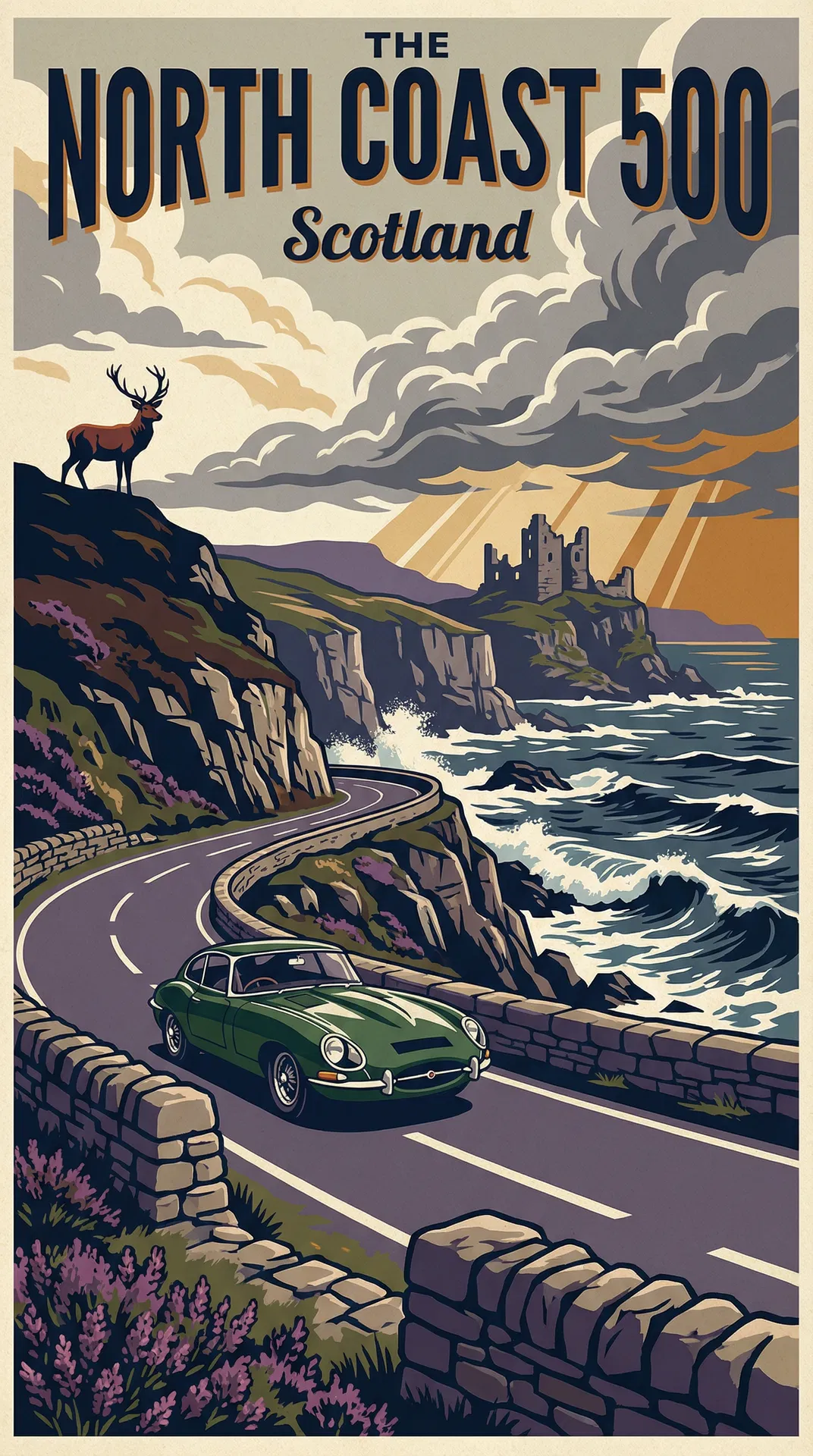
The North Coast 500

"The NC500 passes through some of the least populated land in Europe. Between Durness and Tongue, you can drive for 45 minutes without seeing another car."

The North Coast 500 is a 516-mile circular route around the northern coast of Scotland, starting and finishing in Inverness. It was created in 2015 by the North Highland Initiative, a charity established by Prince Charles to promote tourism in the region, and has since become one of the most popular road trips in Europe.

The route passes through some of the most dramatic and least populated landscape in Britain. The far northwest of Scotland — Torridon, Assynt, Cape Wrath — is geologically ancient: the Torridonian sandstone is 800 million years old, among the oldest exposed rock in the world. The landscape is raw and treeless, shaped by glaciers and Atlantic weather, with a quality of light that changes constantly and is unlike anywhere else in Britain.

The road itself is, in places, a single-track lane with passing places. This is not a metaphor. Large sections of the NC500 are genuinely one car wide, with small lay-bys every few hundred metres where you pull in to let oncoming traffic pass. This requires patience, courtesy, and a willingness to reverse. It also means that the road feels intimate in a way that wider routes do not — you are not driving through the landscape, you are threading through it.

The route can be driven clockwise or anticlockwise. Most people drive clockwise — north up the east coast, west along the top, south down the west coast. Just Gerald recommends anticlockwise: the west coast scenery — Torridon, Assynt, the Bealach na Bà — is the most dramatic, and it is better to approach it fresh, on the first day, than to save it for last when you are tired.

Allow five days minimum. Seven is better. The temptation to drive the whole thing in three days is understandable and wrong. The NC500 is not a race.

Essential

Just Gerald Says

The NC500 is busiest in July and August. May and September offer better weather odds than you might expect, far fewer campervans, and the same landscape. The midges — small biting insects — are worst in July. Bring repellent regardless.
THE STOPS5 min

Applecross and the Bealach na Bà

The mountain pass that earns the village at the bottom

Applecross and the Bealach na Bà

"The Bealach na Bà — 'Pass of the Cattle' in Gaelic — climbs to 626 metres in 9 kilometres. The gradient reaches 20 percent. Caravans are prohibited."

The Bealach na Bà is one of the most dramatic mountain passes in Scotland — not the highest (that distinction belongs to the Cairnwell Pass at 670 metres), but by far the most spectacular. It climbs from sea level at Kishorn to 626 metres in nine kilometres, with gradients that reach 20 percent and hairpin bends that require full lock to navigate. The road was built in the 1820s to connect the remote Applecross peninsula to the rest of Scotland. Caravans and large vehicles are prohibited. The sign at the bottom warns that the road is not suitable for learner drivers.

The view from the summit — on a clear day — takes in the Isle of Skye, the Outer Hebrides, and the Torridon mountains. The descent to Applecross village is through a landscape of bare moorland and ancient rock that feels genuinely remote, even though the village is only nine kilometres from the summit.

The Applecross Inn (Shore Street, Applecross) is the reason to make the descent. A white-painted pub on the shore of Applecross Bay, with views across to Skye and the Cuillin mountains, serving the best seafood on the NC500. The langoustines are caught locally and served simply — grilled, with butter and lemon. The crab claws are extraordinary. The beer is cold and the fire is lit. Book a table for dinner; the pub fills quickly.

The village of Applecross has a population of about 500 people. It has one pub, one shop, one petrol pump, and one of the finest views in Scotland. The campsite above the village is basic and beautiful. The road back out — either back over the Bealach or around the coast road to the north — is equally good.

The Applecross Inn does not take bookings for lunch. Arrive early or be prepared to wait. The wait is worth it.

Essential

Just Gerald Says

The Bealach na Bà is often closed in winter due to ice and snow. In summer, it can be busy with motorcycles and sports cars. The best time to drive it is early morning, before the traffic builds.

Partners & Advertisers
ADVERTISE WITH JUST GERALD
The Kylesku Hotel
ISSUE 12

HOTEL & RESTAURANT · KYLESKU, SUTHERLAND

The Kylesku Hotel

"Nine rooms, a fire, and langoustines from the hotel's own creels."

The Kylesku Hotel is the reason to drive the NC500. Everything else is the journey to get there.

Advertise in Issue 12
ADVERTISE WITH JUST GERALD
The Applecross Inn
ISSUE 12

INN & RESTAURANT · SHORE STREET, APPLECROSS

The Applecross Inn

"Langoustines at the end of the most dramatic road in Scotland."

Drive the Bealach na Bà. Descend to Applecross. Order the langoustines. They were caught this morning.

Advertise in Issue 12
ADVERTISE WITH JUST GERALD
Cocoa Mountain
ISSUE 12

CHOCOLATIER · BALNAKEIL CRAFT VILLAGE, DURNESS

Cocoa Mountain

"The best hot chocolate in Scotland."

You have driven to the edge of Scotland. You deserve the best hot chocolate in the country.

Advertise in Issue 12

Spec placements — contact [email protected] to claim your space

WHERE TO STAY4 min

The Kylesku Hotel

A small hotel at a ferry crossing that became a destination in its own right

The Kylesku Hotel

"The Kylesku Hotel sits at the point where Loch Glendhu and Loch Glencoul meet. The hotel's boat goes out each morning to collect langoustines from the creels. They are on the menu by lunchtime."

The Kylesku Hotel sits at the southern end of the Kylesku Bridge, in the village of Kylesku in Assynt, Sutherland. It was built as a coaching inn in the 17th century, serving travellers crossing the narrows by ferry before the bridge was built in 1984. It has been a hotel in various forms since then, and in its current incarnation — taken over by Sonia and Tanja Viessmann in 2014 — it has become one of the most celebrated small hotels in Scotland.

The building is white-painted and modest from the outside. Inside, the bar has the quality of a room that has been used and loved for a long time — dark wood, low ceiling, a fire, the smell of peat smoke and salt. The dining room looks out over the loch. The menu is built entirely around what is available locally: langoustines from the hotel's own creels, crab from the local boats, venison from the estate, lamb from the hill farms.

The langoustines are the thing to order. They are caught in the morning and served at lunch and dinner, simply prepared — grilled with garlic butter, or cold with mayonnaise. They are among the best shellfish in Scotland, which means they are among the best shellfish in the world.

The hotel has nine rooms. They are comfortable and unpretentious. The breakfast is exceptional — smoked salmon, black pudding, eggs from local hens, proper porridge with cream and whisky.

The surrounding landscape is Assynt — a landscape of isolated mountains rising from a flat, boggy moorland, with lochs scattered everywhere. The mountains here are among the oldest in the world: Suilven, Canisp, Quinag. They rise abruptly from the flat ground in a way that makes them look larger than they are. Walking to the base of Suilven takes about two hours from the road. The summit is another hour beyond that.

Essential

Just Gerald Says

Book the Kylesku Hotel well in advance — it fills quickly in summer. If you can't get a room, the bar is open to non-residents and the langoustines are available at lunch.

FOOD & DRINK5 min

The Whisky Route

The distilleries of the north and what to drink at each one

The Whisky Route

"Old Pulteney is made in Wick, the most northerly mainland distillery in Scotland. The maritime character — salt, brine, a hint of seaweed — comes from the sea air that permeates the warehouses."

The NC500 passes within reach of several of Scotland's finest distilleries. This is not a coincidence — the far north of Scotland has been producing whisky since the 18th century, and the water, the peat, and the maritime climate of the region give the whiskies a character that is distinct from the Speyside or Islay styles that dominate the market.

Glenmorangie (Tain, Ross-shire) is the most accessible distillery on the route, sitting just off the A9 on the east coast. The distillery has the tallest stills in Scotland — 5.14 metres — which produce a particularly light, floral spirit. The 10-year Original is the standard expression and is excellent. The distillery tour is well-run and informative. The visitor centre has a good café.

Clynelish (Brora, Sutherland) is less well-known than Glenmorangie but arguably more interesting. The distillery was built in 1967 next to the original Brora distillery (now reopened as a separate entity). The Clynelish 14-year is waxy, coastal, and complex — one of the most distinctive whiskies in Scotland. The visitor centre is small and the tours are personal.

Old Pulteney (Wick, Caithness) is the most northerly mainland distillery in Scotland, sitting in the fishing town of Wick on the northeast coast. The whisky has a pronounced maritime character — salt, brine, a hint of seaweed — that comes from the sea air that permeates the warehouses. The 12-year is the entry point; the 21-year is one of the great whiskies of the Highlands.

Wolfburn (Thurso, Caithness) is the newest distillery on the route, established in 2013 on the site of an old distillery that closed in 1875. The whisky is young and lively — the Aurora expression, finished in sherry casks, is the most approachable. Worth visiting for the story as much as the whisky.

The correct way to experience these distilleries: one per day, in the afternoon, after the driving is done. Never before.

Essential

Just Gerald Says

All four distilleries offer tours that include a tasting. Book in advance for Glenmorangie and Clynelish in summer. Old Pulteney and Wolfburn are more relaxed about walk-ins.

Partners & Advertisers
ADVERTISE WITH JUST GERALD
The Kylesku Hotel
ISSUE 12

HOTEL & RESTAURANT · KYLESKU, SUTHERLAND

The Kylesku Hotel

"Nine rooms, a fire, and langoustines from the hotel's own creels."

The Kylesku Hotel is the reason to drive the NC500. Everything else is the journey to get there.

Advertise in Issue 12
ADVERTISE WITH JUST GERALD
The Applecross Inn
ISSUE 12

INN & RESTAURANT · SHORE STREET, APPLECROSS

The Applecross Inn

"Langoustines at the end of the most dramatic road in Scotland."

Drive the Bealach na Bà. Descend to Applecross. Order the langoustines. They were caught this morning.

Advertise in Issue 12
ADVERTISE WITH JUST GERALD
Cocoa Mountain
ISSUE 12

CHOCOLATIER · BALNAKEIL CRAFT VILLAGE, DURNESS

Cocoa Mountain

"The best hot chocolate in Scotland."

You have driven to the edge of Scotland. You deserve the best hot chocolate in the country.

Advertise in Issue 12

Spec placements — contact [email protected] to claim your space

THE STOPS5 min

Durness and Cape Wrath

The top of Scotland, where the land runs out and the Atlantic begins

Durness and Cape Wrath

"Cape Wrath is the most northwesterly point of mainland Britain. It is accessible only by ferry and minibus. The lighthouse has been there since 1828."

Durness is a small village on the north coast of Scotland, 11 kilometres east of Cape Wrath. It has a population of about 400 people, a remarkable beach (Balnakeil Bay — white sand, turquoise water, and almost always empty), a craft village in a converted Cold War military installation, and the best chocolate shop in the Highlands.

Cocoa Mountain (Balnakeil Craft Village, Durness) is a small chocolate maker and café in the craft village, run by James and Kate Findlay. The hot chocolate is made with single-origin chocolate and is extraordinary. The truffles are handmade and exceptional. It is, by some margin, the most surprising food experience on the NC500.

Cape Wrath is 11 kilometres west of Durness, accessible only by ferry across the Kyle of Durness and then by minibus along a military road. The Ministry of Defence uses the Cape Wrath range as a bombing and artillery range — the road is sometimes closed for exercises. When it is open, the journey to the lighthouse takes about 45 minutes each way.

The lighthouse was built by Robert Stevenson (grandfather of Robert Louis Stevenson) in 1828. It stands on cliffs 120 metres above the sea. The view — the Atlantic in three directions, the Orkney Islands visible on a clear day to the northeast — is one of the most remote and affecting in Britain.

The cliffs at Cape Wrath are among the highest sea cliffs in Britain, rising to 281 metres at Clo Mor, two kilometres east of the lighthouse. The seabird colonies here — puffins, guillemots, razorbills, fulmars — are among the largest in Scotland.

The ferry across the Kyle of Durness runs from May to September, weather permitting. The crossing takes ten minutes. The minibus holds about twelve people. Book in advance in summer.

Essential

Just Gerald Says

The ferry to Cape Wrath runs from the Keoldale slipway, 2 kilometres south of Durness. Check the schedule at capewrath.org.uk before you go — the ferry doesn't run in bad weather and the MoD sometimes closes the road without notice.

Just Gerald — Curated Itinerary

Your Best
Day Ever

Two paths through The North Coast 500. Every decision already made. Choose your day.

Solo / Couple

8:00am

Depart Inverness

Velocity Café — Crown Avenue, Inverness

Fill the tank at the Tesco on Millburn Road. Buy a coffee from Velocity Café. Drive anticlockwise: west first, then north, then east back to Inverness. The west coast scenery is the best — save it for when you're fresh.

Gerald says: The NC500 is a loop. Anticlockwise means the best scenery — Torridon, Assynt, the Bealach na Bà — comes first.

11:00am

Torridon

Beinn Eighe National Nature Reserve — Kinlochewe, Ross-shire

The Torridonian sandstone mountains are 800 million years old. The landscape is ancient and treeless. Stop at the Beinn Eighe visitor centre. Walk the Mountain Trail if you have time.

Gerald says: The Mountain Trail is 4 miles and takes 3-4 hours. The Woodland Trail is 1 mile and takes 1 hour.

1:30pm

Applecross Inn

The Applecross Inn — Shore Street, Applecross

Drive the Bealach na Bà — one of the most dramatic mountain passes in Scotland, 20% gradient, hairpin bends, 626 metres at the summit. Descend to Applecross village. The Inn is on the shore. Order the langoustines. They were caught this morning.

Gerald says: The Applecross Inn does not take bookings for lunch. Arrive before 1pm to avoid a wait.

4:00pm

Gairloch Beach

Gairloch Beach — Gairloch, Ross-shire

A long white sand beach on the west coast with views to the Outer Hebrides. Almost always empty. The light in the late afternoon is extraordinary.

Gerald says: The beach at Big Sand, 3km north of Gairloch, is quieter and equally beautiful.

7:00pm

Kylesku Hotel

The Kylesku Hotel — Kylesku, Sutherland

The best hotel on the NC500. Nine rooms, a bar with a fire, langoustines from the hotel's own creels. Book months in advance.

Gerald says: The bar fills quickly in the evening. Arrive by 7pm to get a seat by the fire.

9:00pm

Dinner

The Kylesku Hotel Restaurant — Kylesku, Sutherland

The menu is built entirely around what is available locally. The langoustines are the thing to order — grilled with garlic butter. The crab claws are extraordinary.

Gerald says: The langoustines are caught in the morning and served at dinner. They are among the best shellfish in Scotland.

Travelling with children?

From the Newsstand

More Best Days Ever