THE BEAUTIFUL MACHINES: ART DECO RACING CARS OF THE 1930S
Before aerodynamics became a science, racing cars were designed by artists. The results were extraordinary.
Field Notes
The 1930s produced the most beautiful racing cars ever built. This is not a matter of opinion -- it is a matter of geometry, proportion, and the fact that nobody had yet invented a wind tunnel.
01
FORM BEFORE FUNCTION
The 1930s produced the most beautiful racing cars ever built. This is not a matter of opinion -- it is a matter of geometry, proportion, and the fact that nobody had yet invented a wind tunnel. The cars of the art deco era were shaped by intuition, by aesthetics, by the conviction that a beautiful machine would also be a fast one. Sometimes this was wrong. Mostly, it was right.
The art deco movement -- which peaked in the late 1920s and 1930s -- was obsessed with speed, modernity, and the machine age. Its visual language was all geometric precision, streamlined forms, bold contrasts of light and dark, gold and black and cream. The racing cars of the era absorbed this aesthetic completely. They were low and narrow, with long bonnets covering supercharged engines, exposed exhaust pipes running along the flanks, wire-spoke wheels, and cockpits so small that drivers sat with their shoulders above the bodywork. They looked like they were moving even when they were standing still.
"The cars of the art deco era were shaped by intuition, by aesthetics, by the conviction that a beautiful machine would also be a fast one."
ADVERTISEMENT
JUST GERALD MAGAZINE
Coffee 'til Cocktails — Bottled and Bound
02
THE BUGATTI TYPE 35: THE STANDARD OF EXCELLENCE
Ettore Bugatti was an Italian-born Frenchman who believed that a racing car should be as beautiful as a piece of jewellery. The Type 35, introduced in 1924, was his masterpiece. The aluminium body was hand-formed. The wheels were cast in a single piece, with the brake drums integrated -- a technical innovation that also happened to look extraordinary. The eight-cylinder engine was a work of mechanical sculpture, with a single overhead camshaft and a crankshaft supported by five main bearings.
The Type 35 won over 2,000 races between 1924 and 1931. It came in multiple variants: the Type 35A (for amateurs), the Type 35B (supercharged 2.3-litre, the most powerful), the Type 35C (supercharged 2.0-litre), and the Type 35T (2.3-litre, unsupercharged, for the Targa Florio). All of them were painted in the same French blue -- a colour that became so associated with Bugatti that it is now simply called "Bugatti Blue."
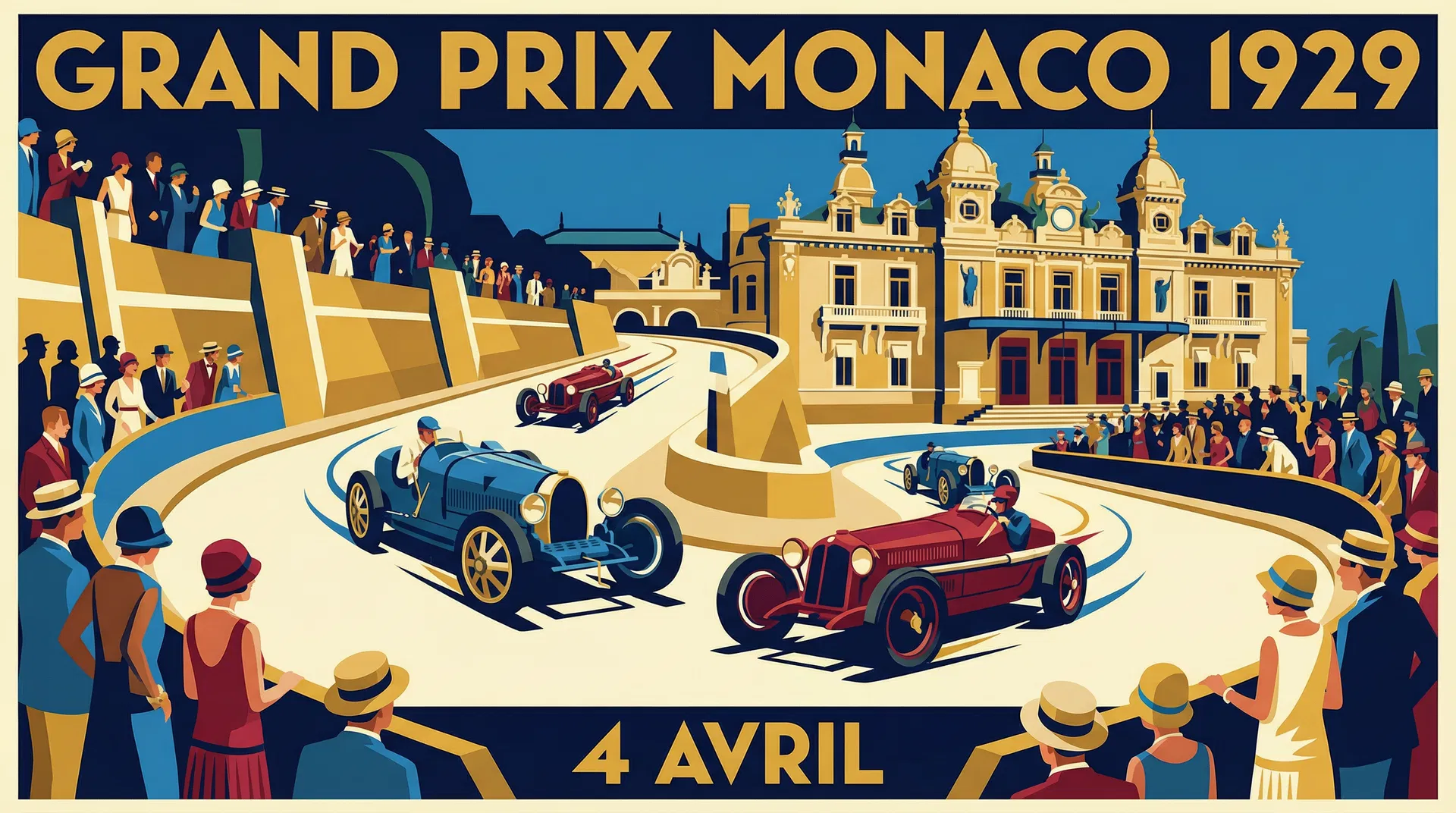
The Type 35B that William Grover-Williams drove to victory in the 1929 Monaco Grand Prix produced 140 horsepower from a 2.3-litre engine with a Roots-type supercharger. It weighed 750 kilograms. It could theoretically reach 215 km/h, though not on the streets of Monaco. It had drum brakes -- four of them, cooled by the famous aluminium wheels. It was, by any measure, the finest racing car of its era.
03
THE ALFA ROMEO 8C: ITALIAN RED VS. FRENCH BLUE
If Bugatti represented the French approach to racing -- elegant, precise, jewel-like -- then Alfa Romeo represented the Italian one: passionate, powerful, slightly operatic. The Alfa Romeo 8C 2300 Monza, introduced in 1931, was the car that finally broke Bugatti's dominance at Monaco.
The 8C was designed by Vittorio Jano, an engineer of genius who had previously worked for Fiat. The twin-supercharged 2.3-litre straight-eight engine produced 155 horsepower -- more than the Bugatti -- and the car was lighter and more nimble than its predecessor. It was painted in Italian racing red, which made the battles between the French blue Bugattis and the Italian red Alfas at Monaco in the early 1930s one of the great visual spectacles in motorsport history.
Tazio Nuvolari drove the 8C Monza to victory at Monaco in 1932. Nuvolari was, by any measure, the greatest driver of the pre-war era. He was small -- 5'4" -- and drove in a yellow jersey and blue trousers, which made him easy to spot in the crowd. He was also completely fearless. Ferdinand Porsche called him "the greatest driver of the past, the present, and the future." Enzo Ferrari, who ran the Scuderia Ferrari team that fielded the Alfa Romeos, said simply: "He was the greatest."
The 1933 Monaco Grand Prix was one of the great races of the era -- a battle between Achille Varzi in a Bugatti and Nuvolari in an Alfa Romeo that lasted the entire race. Varzi won by a margin of seconds. Motor Sport magazine described it as "the blue and the red, France and Italy, Varzi and Nuvolari, Bugatti and Alfa Romeo, waging a battle that will be talked about for years." They were right.
— ADVERTISEMENT —

04
THE SILVER ARROWS: GERMANY ARRIVES
By the mid-1930s, the art deco era of racing was giving way to something more purposeful and, frankly, more sinister. Mercedes-Benz and Auto Union -- both backed by the Nazi government's desire to demonstrate German technological supremacy -- arrived at the circuits with cars of extraordinary power and sophistication. The Mercedes W25 and W125, and the Auto Union Type A through D, were painted silver -- not by choice, but because the German racing authority required cars to be painted in national colours, and the German national colour was white. When the W25 arrived at the 1934 Eifelrennen overweight, the mechanics stripped the white paint to save weight, revealing bare aluminium. The "Silver Arrows" were born.
These cars were faster than anything that had come before -- the W125 produced 592 horsepower in qualifying trim -- but they lacked the visual elegance of the Bugattis and Alfas. They were purpose-built weapons, not works of art. The art deco era of racing was effectively over.
But the cars of 1929 to 1934 -- the Bugatti Type 35B, the Alfa Romeo 8C Monza, the Maserati 8CM -- remain the most beautiful racing machines ever built. They are the cars that define Monaco, that define the era, that define what a racing car can look like when it is designed by someone who cares as much about beauty as about speed.
THE VERDICT
The Bugatti Type 35B, the Alfa Romeo 8C Monza, the Maserati 8CM -- the most beautiful racing machines ever built. Full stop.
Keep Reading