THE LONG ROAD TO MONTE CARLO: A HISTORY OF THE RALLY
Since 1911, drivers have been setting out from the far corners of Europe -- through snow, fog, and mountain passes -- bound for Monaco.
Field Notes
In January 1911, twenty-three cars set out from eleven different cities across Europe. Their destination was Monaco. Their route was whatever they chose.
01
THE ORIGINAL IDEA
In January 1911, twenty-three cars set out from eleven different cities across Europe. Their destination was Monaco. Their route was whatever they chose. The event was called the Rallye Monte-Carlo, and it was the invention of Prince Albert I of Monaco, who wanted to demonstrate the reliability of the modern automobile and promote Monaco as a tourist destination in the winter months.
The first winner was Henri Rougier in a Turcat-Méry 25 Hp, who left from Paris and covered 1,020 kilometres to reach Monaco. The judging was partly based on the elegance of the car and the comfort of the passengers -- which caused considerable controversy when the results were announced, and which tells you something about the era. Rougier was declared the winner anyway.
The concept was simple and brilliant: start from anywhere in Europe, converge on Monaco, and the car that arrives in the best condition wins. This meant that the rally was not a race against other competitors -- it was a race against the conditions. Snow in the Alps. Fog in the Massif Central. Ice on the mountain passes. The Monte Carlo Rally was, from the beginning, a test of endurance, navigation, and the ability to keep a car running through a European winter.
ADVERTISEMENT
JUST GERALD MAGAZINE
Coffee 'til Cocktails — Bottled and Bound
02
THE GOLDEN AGE: 1930S TO 1960S
The rally grew rapidly in the 1930s. By 1930 there were 100 entries. By 1953 -- the peak year -- there were 404. Starting points spread across Europe: Paris, Athens, Oslo, Lisbon, Warsaw, Monte Carlo itself. Competitors drove through the night, navigated by map and compass, and arrived in Monaco exhausted, frozen, and triumphant.
The cars of the golden age were extraordinary. Sunbeam-Talbots, Citroën DS, Jaguar Mark VIIs, Ford Zephyrs -- production cars driven by amateurs and professionals alike, often with a co-driver who navigated while the driver focused on keeping the car on the road. The Monte Carlo Rally was, uniquely, a competition that anyone could enter. You did not need a factory team or a racing licence. You needed a reliable car, a good co-driver, and the willingness to drive through a European winter.
The 1966 rally was the most controversial in the event's history. The first four finishers -- three Mini-Coopers driven by Timo Mäkinen, Rauno Aaltonen, Paddy Hopkirk, and Roger Clark's Ford Cortina -- were all disqualified on a technicality involving headlight bulbs. The winner by default was Pauli Toivonen in a Citroën ID, who found the situation so embarrassing that he refused to accept his award. The headline in Motor Sport read: "The Monte Carlo Fiasco." Teams threatened to boycott. The event survived, but its reputation was damaged.
"The Monte Carlo Rally was, from the beginning, a test of endurance, navigation, and the ability to keep a car running through a European winter."
03
THE COL DE TURINI: THE NIGHT OF THE LONG KNIVES
The most famous stage in the Monte Carlo Rally is the Col de Turini -- a 31-kilometre mountain road that runs from La Bollène-Vésubie to Sospel, over a pass at 1,607 metres that is almost always covered in ice and snow in January. The stage is run at night. Thousands of spectators line the road, many of them throwing snow onto the tarmac to make it more difficult. The headlights of the cars cut through the darkness like knives -- which is why the stage is known as the "Night of the Long Knives."
The Turini is everything that makes the Monte Carlo Rally unique: the combination of technical difficulty, extreme conditions, and spectacular scenery that no other rally stage can match. Sébastien Loeb set one of the fastest times in the modern era there in 2005 -- 21 minutes 40 seconds for 31 kilometres of mountain road, at night, in January. It is, by any measure, one of the great tests in motorsport.
The rally is still running. It is now part of the FIA World Rally Championship, and the cars are 300-horsepower all-wheel-drive machines that bear no resemblance to the Turcat-Méry that Henri Rougier drove in 1911. But the route is essentially the same. The Col de Turini is still there. The snow is still there. And every January, drivers still set out from the far corners of Europe, bound for Monaco.
THE VERDICT
The Monte Carlo Rally has been running for 115 years. It will be running for another 115. Some things are simply too good to stop.
Keep Reading
MORE FROM MONACO
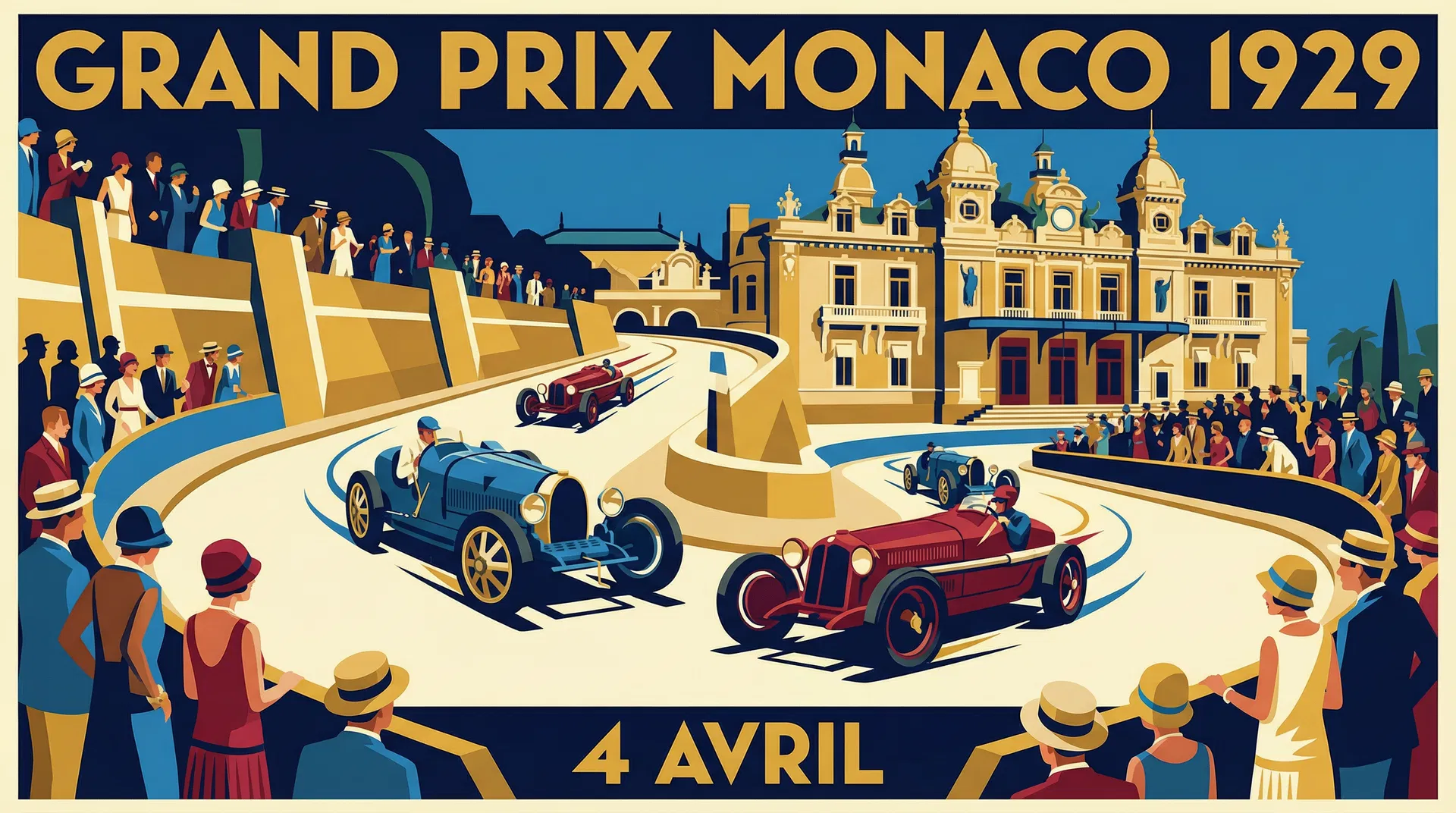
THE RACE THAT STARTED EVERYTHING: MONACO GRAND PRIX, 1929
On April 14, 1929, twenty cars lined up on a cobblestone street in Monaco. The w…
THE BEAUTIFUL MACHINES: ART DECO RACING CARS OF THE 1930S
Before aerodynamics became a science, racing cars were designed by artists. The …